

In this third piece on Donella Meadows’ formulation of Systems Thinking in our book club reading of her Thinking in Systems builds on the past two weeks.
First, we looked at her tripartite composition of a system: elements, interconnections, and function/purpose (the things, the relationships and flows between them, and the goal they are oriented towards). Then last week we looked at a dynamic flow of this system with a stock (an accumulation of an element/s) and flows (the inflows and outflows that are increasing and decreasing this stock).
This week, we are building on this model of stocks and flows by looking at feedback loops. This adds another layer of dynamic animation to this model of a system.
Meadows introduces us to two kinds of feedback loops that change the relationship of stocks and flows: balancing and reinforcing feedback loops.
Balancing feedback loops
Balancing feedback loops, aka stabilising or regulating loops, are just what they sound like: feedback mechanisms which keep the stock at the same level. Let’s illustrate with Meadows’ example:
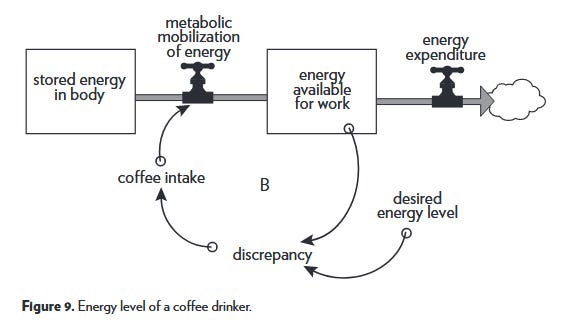
You have two stocks in this diagram. Firstly, the amount of energy stored in your body and secondly, the energy you have available to work. Between these you have the flow between them of metabolic energy. If you’ve consumed a pot of coffee and a bag of jelly beans for breakfast, this will be a torrent of energy flooding into your “energy available for work” stock.
But as the day wears on and the outflow of energy expenditure decreases, this “energy available for work” stock, a feedback loop begins. As the energy available dips below your desired energy level, the system that is you notes a discrepancy. You notice that you’re losing focus, that you are feeling lethargic and demotivated. But, you say to yourself, “I’ve only been working for 20 minutes, so I really can’t stop for the day,” and so you go about fuelling up. You pour more coffee into the system, raising the stock of energy available for work, and you get back to it.
This is a balancing feedback loop. Something in the system, in this example your mind, catches a discrepancy between where the stock is and where it ought to be, and it sets things in motion to bring the stock back into balance.
But, as Meadows shows, you don’t need conscious intentionality in a system to have such feedback loops. Widening the frame a little, she shows us a cup of coffee in the system of the world of thermodynamics:

In this example, we have the stock of the coffee’s temperature and its outflow into the environment. If you start with a boiling pot of coffee at ~96ºC and a room temperature of ~20ºC, and you add in the laws of physics, what you get is a flowing of heat from the coffee to the room.
If I’m being honest, I don’t care for this example. If this is a balancing feedback loop, then the word seems kind of pointless, doesn’t it? Where’s the discrepancy happening? There is no adjustment. I see no balancing here. I guess in the broadest cosmic sense, it is part of a system of physics, but it seems almost…trivial? Maybe I’m misunderstanding something, but I’m not impressed. This system is hardly greater than the sum of its parts. Of course, that’s just my opinion, so you can take it or leave it (or correct me if I’m missing something).
Reinforcing Feedback Loops
Reinforcing feedback loops, aka runaway loops, are a bit more exciting. Rather than orbiting a homeostatic balancing point, reinforcing feedback loops take us on a journey of vicious cycles and virtuous cycles. They can take us up or they can take us down, but they are most certainly steering us clear of the current level of our stock.
Meadows cites an example close to her heart (given her Limits to Growth thesis and Club of Rome membership) with the breeding of rabbits:
“The more rabbits there are, the more rabbit parents there are to make baby rabbits. The more baby rabbits there are, the more grow up to become rabbit parents, to have even more baby rabbits.”
Or the rather more mellifluous:
“The more I practice piano, the more pleasure I get from the sound, and so the more I play the piano, which gives me more practice.”
The definition of a reinforcing feedback loop is that the more of the stock there is, the more stock there is. It’s a systems thinking way of framing the Biblical saw
“For whosoever hath, to him shall be given, and he shall have more abundance: but whosoever hath not, from him shall be taken away even that he hath.”
To those who have a million dollars in their bank account, interest shall accrue, to those mired in debt, interest repayments shall also accrue. The rich get richer, the poor get poorer. Here’s one of Meadows’ diagrams to this effect:

I came across another example of a reinforcing feedback loop this week. I’ve been listening to Mary Beard’s SPQR (I am hooked. God, I missed Antiquity) and one of the big questions about Ancient Rome is why? Why did this random town in Italy end up conquering half the world?
One particular explanation jumped out as an obvious example of a reinforcing feedback loop. In the early days of its expansion, the Roman Republic was rather unusual in that its conquered territories didn’t pay taxes, but they did have to supply soldiers and the means to support them. So for every bout of conquering, Rome’s army grew larger and larger and larger until they conquered most of the known world. The bigger their army got, the bigger their army got.
Of course, this runaway train was to be the Republic’s undoing. When they ran out of worthy adversaries, Rome began to collapse in on herself (much like the Greek alliance after defeating the Persians in 479). Commenting on this implosion of Rome, the ancient Roman historian Sallust noted:
“before the destruction of Carthage the people and senate of Rome together governed the republic peacefully and with moderation. There was no strife among the citizens either for glory or for power; fear of the enemy preserved the good morals of the state. But when the minds of the people were relieved of that dread, wantonness and arrogance naturally arose, vices which are fostered by prosperity. Thus the peace for which they had longed in time of adversity, after they had gained it proved to be more cruel and bitter than adversity itself. For the nobles began to abuse their position and the people their liberty, and every man for himself robbed, pillaged, and plundered. Thus the community was split into two parties, and between these the state was torn to pieces.”
Every runaway feedback has to end somewhere.