

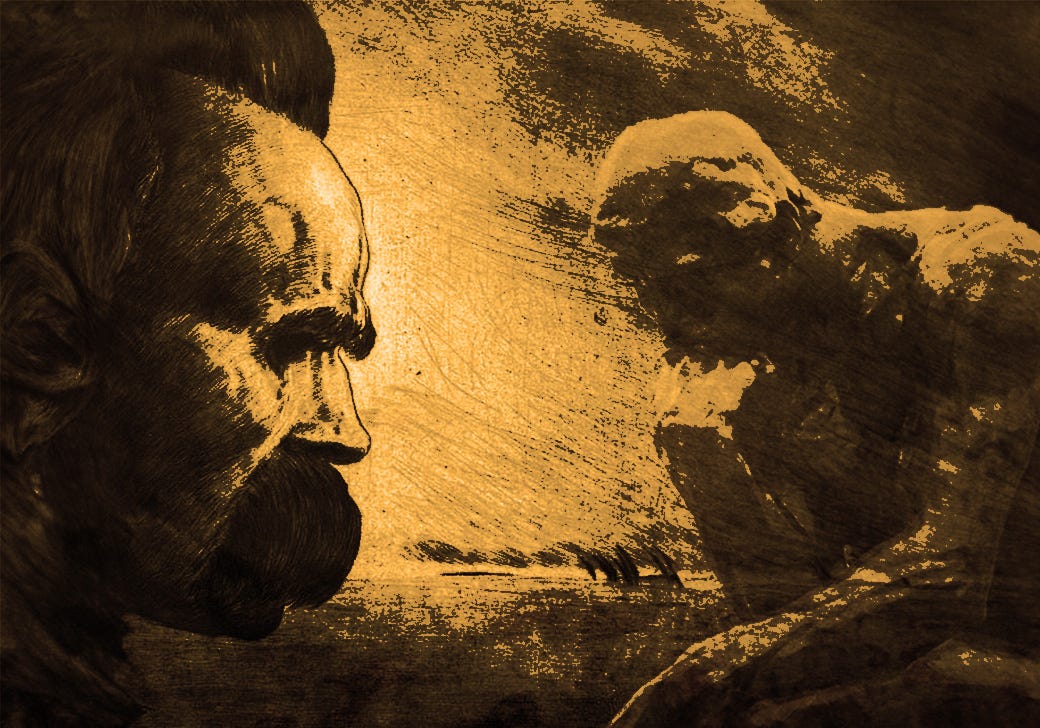
If you've ever picked up a book by Nietzsche, you’ll have to admit it's a unique experience. You might love it, you might hate it but you can't deny that it's unforgettable. That’s because the German philosopher wrote in aphorisms — short passages like little bombs of pure thought. Much like hobbits, you can read an aphorism in no time, and yet, on the hundredth return, it can still surprise you.
By and large, these thought bombs stand alone, and so, if one goes completely over your head, you can just keep moving. This is what makes the task of reading Nietzsche both brutally disorienting but also oddly forgiving. You might miss what's going on in this aphorism but hit something life-changing or mind-altering in the next one. That’s always been my experience of reading Nietzsche.
This is what gives his work so much vitality and such a re-readability factor. His aphorisms are the gifts that keep on giving.
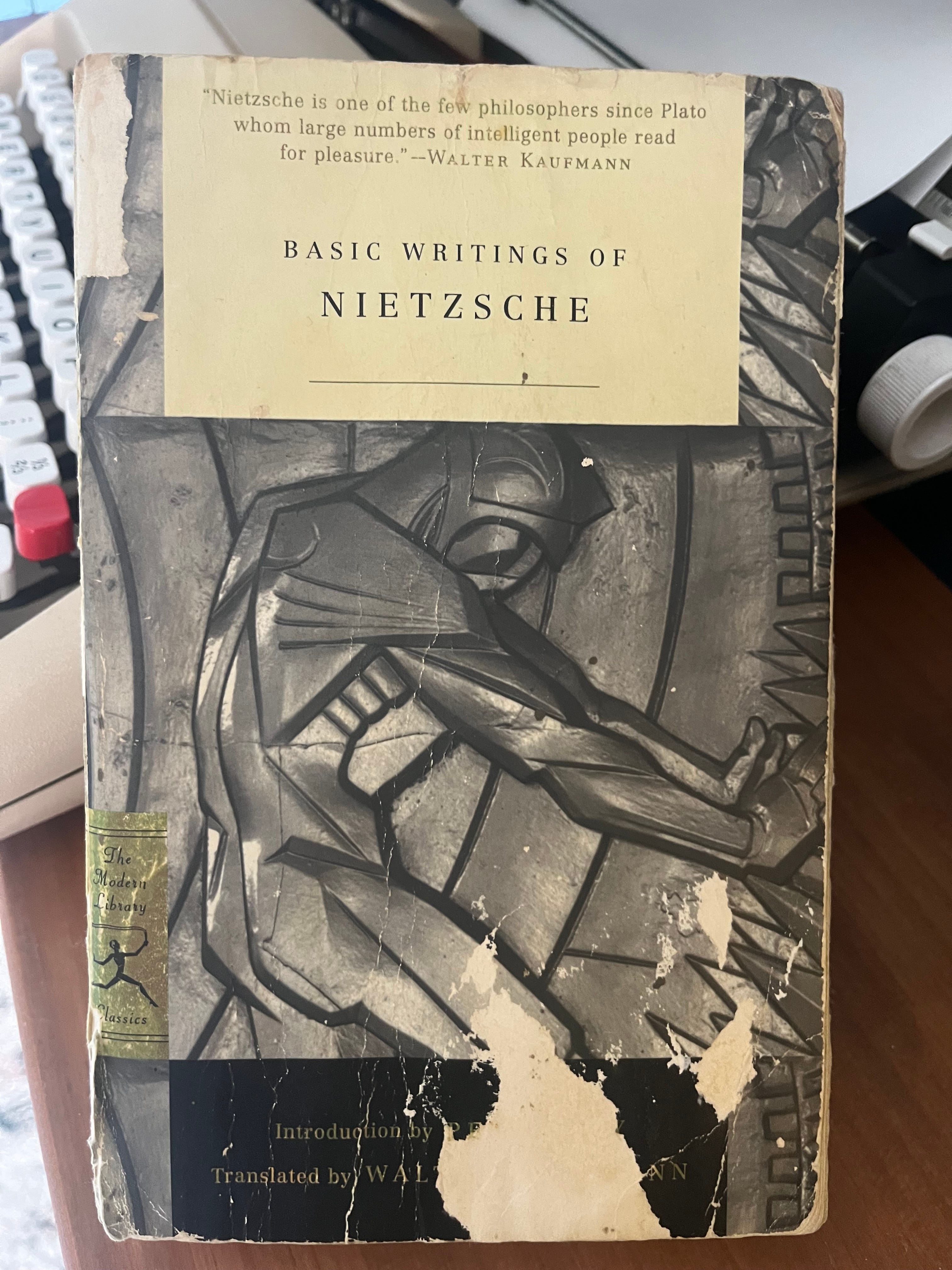
This is the first ever book of Nietzsche's writings I owned (as you can tell by the beat-up shape of the thing) and up at the top there it has the following quote from the translater Walter Kaufmann that I’ve always adored:
Nietzsche is one of the few philosophers since Plato whom large numbers of intelligent people read for pleasure.
Flicking through Beyond Good and Evil (one of the books contained in this volume) you can see that some aphorisms are super short like §106 at just six words long. Most of them though are somewhere between a paragraph and a page with the longest one I can find being §260 which is about four full pages.
When you first encounter this you might be wondering what the hell Nietzsche is up to. Why can't he write like a normal person with a start a middle and an end — a few premises leading to a conclusion; a set of points that converge on a denouement?
The answer lies in his way of thinking. As he showed in the work of his most popular in academia On the Genealogy of Morals he is more than capable of writing in the linear fashion that we are used to. But that book is the exception among his later works.
The thing is that this just isn't how Nietzsche philosophised. He wasn’t a “sit at your desk and rigorously work through your thoughts” kind of guy. The reason why his thinking is so dynamic and why it has been the love of everyone from far-right Fascists, far-left French Postmodernists and far-out techno-optimists is that his writings are overflowing with life.
He doesn’t get hung up on evolving one thought. His philosophy isn't that of the diligent cartographer mapping out the topography of an established territory. Nietzsche is less Mason-Dixon and more Lewis and Clark. With On the Genealogy of Morals he was ensnared enough by one train of thought that he settled down to develop it in a more traditional intellectual style but aside from that he preferred to keep moving and keep evolving. The other exception to the rule Thus Spoke Zarathustra only amplifies this impression — it was a bizarre Biblical sort of text that wasn't aphorism but certainly wasn’t your linear academic style either.
The reason his thinking has been the love of everyone from far-right Fascists, far-left French Postmodernists and far-out techno-optimists is that his writings are overflowing with life.
This light-footedness allows him to explore a thought that comes up and just as quickly let it go and never talk about it again as he did with the “übermensch”. Instead of getting hung up on one big idea like Isaiah Berlin's hedgehog Nietzsche epitomises Berlin's fox who knows many things and explores a broad territory.
The key to understanding the fertility of the aphoristic fox Nietzsche is to understand how he thought. And the key to this thinking process is walking.
The Walking Philosopher
“The sedentary life is the very sin against the Holy Spirit. Only thoughts reached by walking have value.”
— Twilight of the Idols §34
Nietzsche never had the best health and by his mid-thirties, it was so bad he had to retire from his professorship at the University of Basel in Switzerland (at the ripe age of 35). It is interesting to note that his works up to this point — The Birth of Tragedy and the four essays of his Untimely Meditations were all linear pieces.
In the nine years between his retirement and his steep descent into madness at the age of 44, Nietzsche wrote his greatest works from The Gay Science and Thus Spoke Zarathustra to Beyond Good and Evil, On the Genealogy of Morals and The Twilight of the Idols.
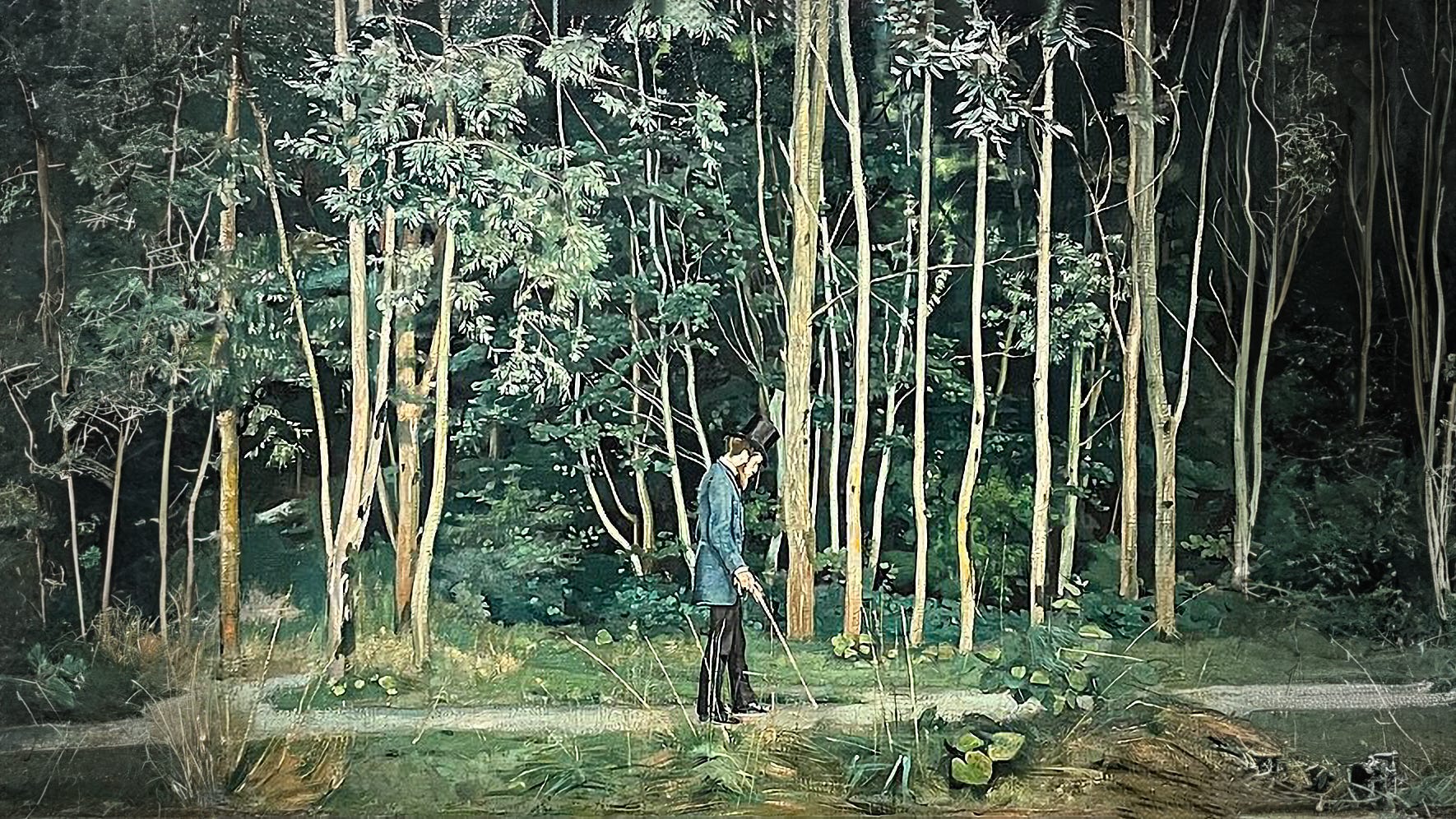
It is no coincidence that as his writing was ramping up so too was his walking. The year after leaving Basel he began his migratory existence in search of the promised land where his health would improve. One of the places he stayed was in the German Black Forest where he wrote:
“I am walking a lot, through the forest, and having tremendous conversations with myself.”
During this phase, he walked one hour in the morning and three hours every afternoon.
As the years went on this ramped up. A couple of years later he wrote:
“I would walk for six or eight hours a day, composing thoughts that I would later jot down on paper.”
And within a couple more years he would proclaim that he was doing:
“ten hours a day of hermit’s walking.”
It should go without saying that this very sick man probably wasn’t walking ten hours straight a day. I assume what he means is that he was on the trail for 10 hours and I'm sure a large chunk of that time was spent jotting in his notebook capturing the insights that were fed to him.
This would be no way for a hedgehog to write. The hedgehogs like Kant or Hegel would find this to be a nuisance. Their work is done in a chair at a desk. They are diving down on one thought so sustained laser focus is their superpower. Theirs is an active thinking.
But that is not the only type of thinking and it certainly wasn’t Nietzsche’s. His aphoristic works were exemplars of passive thinking — he was just the one writing it down and feeding it new sources of inspiration in the form of books and conversation. From there the psyche/Muse cooked it up and fed new philosophy to him bit by bit.
And that is why the walking is so essential.
The Walking Muse

“The alchemists are of the opinion that the artifex [craftsman] is the servant of the work, and that not he but nature brings the work to fruition.”
— C. G. Jung, Practice of Psychotherapy
As longtime followers of the channel will be aware, last summer I walked the most famous hiking trail in Europe — the Camino de Santiago which starts in the French Pyrenees and makes its way 500 miles across the north of Spain to the city of Santiago where legend has it that the apostle of Jesus, Santiago (Saint James) is buried. Along with Rome and Jerusalem, it’s one of the three classic pilgrimages of Christianity.
There was a beautiful week on that trek after my mind had settled but before it had become the social affair that the Camino inevitably turns into. It was the week I understood Nietzsche’s creative process because I was experiencing it.
Now I'm not saying I am a new Nietzsche or anything — god knows the world doesn't need another one of those (sorry Fritz). What I'm talking about is a certain rhythm — a certain groove Nietzsche’s way of thinking and his creative process worked by.
On the days of this week, I would rise as usual in the early hours of the morning and I would set off hiking. In the two or three hours before my first breakfast stop, my mind would be idling over. I would be in what Chris Bailey calls Scatterfocus — where I let my mind wander freely where it would.
I'd be looking at the beauty around me — the fields of wheat and oats rippling like a cereal ocean in the morning light. And inevitably my mind would wander to mundane business — how long to the next stop, how many kilometres today, what I was going to have for breakfast and so on. And then, I’d drift back to the trail drinking in the beauty and looking down the path ahead “as far as I could/ To where it bent in the undergrowth”.
It was like lying in a boat in a cove — with the boat bobbing now towards the internal world and now the external world. Then, amid these circling reveries and sensations, there would be a loud BANG of inspiration. A lightbulb would go off like a gunshot. My mind would race with thought — like a letter had just arrived from the gods. From there I’d lasciviously unpack this insight ravaging it from every angle to see what was in it. When I had wrung all the archetypal ambrosia out of it, my mind would naturally return to its reveries until I reached the next village where I would stop, have a cup of coffee and a pastry, take out my notebook and record the insight that had come to me.
With my physical and creative hungers satiated, I'd get back on the trail and walk and fall back into reverie until another shot of inspiration struck and once again I'd greedily sieve through it until there was nothing left for my mind to grip onto. Another delicious café con leche would follow with notebook out again to give flesh to the thought on paper. And on I would go again.
This cadence continued for a whole week — with insight after insight emerging in each session of walking-writing (if any of you Germans can come up with one of your wonderful mashup portmanteaus to put a word to this type of thinking I'd love to hear it down in the comments). Somewhere in that week it crystallised for me: this is exactly how Nietzsche wrote his works.
I recognised it in the style of what was emerging. It's like I could hear the same drummer that he heard. Or to use the language of Stephen Pressfield (who in turn filched it from the ancients starting with Homer and Hesiod) I was inspired by the same Muse.
This was the Muse of walking (I know — not one of the canonical daughters of Mnemosyne but what care I for canon). As I flicked through these notebooks I noticed that there were common themes between the various bits of writing but each one stood alone separate and yet coming from the same substrate. It gave new meaning to the idea of The Living Philosophy — a double meaning where I realised that this philosophy was something that I merely had to attend to — an exercise in passive thinking.
As I discovered, if I walk and I write then this philosophy will keep showing up in eureka after eureka and it will unfold and evolve and transform. It wasn’t that the philosophy was about living — the original meaning of The Living Philosophy for me — but that the philosophy itself was alive and evolving.
That's what I see in Nietzsche's philosophy — something living. To use a philosophical metaphor that goes all the way back to Socrates — Nietzsche was a midwife to a philosophy rather than the creator.
Of course, the process wasn't entirely passive. It wouldn't have happened if Nietzsche was sitting at home watching 19th-century Seinfeld. It happened because he was walking.
How to Think Like Nietzsche

“I insist that people should finally stop confounding philosophical laborers, and scientific men generally, with philosophers; precisely at this point we should be strict about giving “each his due,” and not far too much to those and far too little to these.
It may be necessary for the education of a genuine philosopher that he himself has also once stood on all these steps on which his servants, the scientific laborers of philosophy, remain standing—have to remain standing.”
— Beyond Good and Evil §211
Nietzsche isn’t the first walking philosopher in the field's distinguished history. Both Plato’s and Aristotle’s schools of philosophy in Ancient Greece were founded in gymnasiums. While Plato’s thinkers were named after the school itself (from the forest of Hekademos in Athens — hence Academics), Aristotle’s school of thinkers were instead named the Peripatetics — the walking philosophers. Aristotle, it seemed, liked to walk and philosophise.
Henry David Thoreau was another zealous advocate of walking saying that his “health and spirits” required at least four hours a day “sauntering through the woods and over the hills and fields” to remain in top shape.
And if we want to emulate Nietzsche there’s an important insight that Thoreau hints at in his book Walking:
“I am alarmed when it happens that I have walked a mile into the woods bodily, without getting there in spirit. In my afternoon walk I would fain forget all my morning occupations and my obligations to Society. But it sometimes happens that I cannot easily shake off the village. The thought of some work will run in my head and I am not where my body is — I am out of my senses.”
This from Thoreau who was used to walking four hours a day. I have found that even in my 1-2 hour daily walks there's not enough time to shake off the village. As I was saying with my Camino experience, I didn’t slip into the aphoristic writing mode immediately. It took more than a week before the dust had sufficiently settled that I could really feel that I’d left the village behind.
By the same token, the weeks after that golden week of inspiration weren't philosophically fruitful because I’d found a whole new village in my fellow Camino hikers.
So it’s not merely a matter of walking or of walking alone — something which I still did for the most part in the weeks after my inspired week. It’s a question of letting the dust of the village settle. It’s in this quietness that the Muse can emerge.
It's funny that part of what makes Nietzsche’s life so undesirable — the isolation and the lack of love and connection (though I should stress not as much as popularly portrayed) — is what made him so fertile. It's the double-edged sword of the hermit. It reminds me of a line of Emerson’s:
“When half-gods go,
The gods arrive.”
Or of Blake’s:
“God appears and God is light
To those poor souls who dwell in night
But does a human form display
To those who live in realms of Day.”
Nietzsche walked in his solitude and out of that walking came aphorism after aphorism so that the writing of his books must have seemed relatively easy — like a clown pulling tissues out of their sleeve.
Of course, there’s a massive caveat that has to be added. What we’ve explored in this article is how to think like Nietzsche in the sense of tapping into the fertile rhythm of his inspiration. But Nietzsche's works are so powerful and valuable to the extent that he is rooted in the Western intellectual tradition. If you can name a philosopher or great writer from the previous two millennia then Nietzsche probably takes a stab at them at some point. There’s much talk about “the ugliest of all” Socrates, Descartes “the father of rationalism, and the suicide of European intellect” some talk of Napoleon and Hegel and the “Chinese of Königsberg” Immanuel Kant.
Nietzsche's writings are so enjoyable because they are like a grand tour through the history of thinking. His reservoir of knowledge is vast and this was the prima materia he was working with when he went out walking. These were the ingredients that the psyche had to cook with. And my god did they cook.