

Yes yes, yet another Jordan Peterson article. But for those who hate Peterson and see no value in him, I hope you’ll get something out of this. And don’t worry it’s not about Peterson’s fits of crying over his influence as a culture warrior’s Tony Robbins.

No I want to try and show you why intelligent people once loved Peterson and had high hopes for him. I want to show you Peterson before his dramatic and progressive transformation into a supervillain.

It’s hard to believe it today but Jordan Peterson was once interested in bridging the cavernous polarities in the culture. Not just interested but he wrote what I can only describe as my favourite manifesto ever articulating what this looks like. [I was going to adjectivise “manifesto” with psychology or philosophy but the piece is so laced with metaphor that it would be misleading to apply such terms. Listeners of Decoding the Gurus, you have been warned; as for you Integral or Metamodernists out there, prepare to swoon.]
The paper in question is a strange strange piece written in 2005 called Peacemaking Among Higher Order Primates. It was written for a collection called The Psychology of Resolving Global Conflicts published by a respected academic publishing house. This fact adds another layer of absurdity to the whole thing. Here’s some taster lines so you can see what I mean:
“The truly idealistic man is an avatar of the reality of the unknown, and not a loser masquerading in moral dress.”
“the peacemaker must feel his way. To feel one’s way is to make intimate contact with the unknown, and to risk the contamination that intimate contact may bring”
“The forges of the gods exist in the transcendent domain, beyond the local. The peacemaker must have subjected himself to the heat and pressure of these forges; must have become something hard and translucent, in consequence, but also something protean and subtle. Gemstones shine most brightly out of the darkness, not the light.”
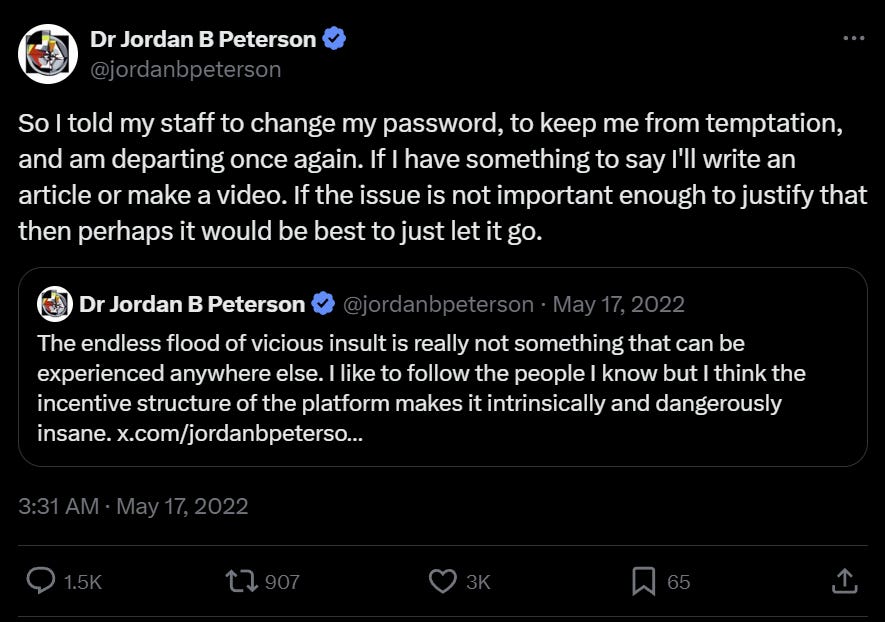
You can probably already grasp the general meaning of this piece just from those snippets. There’s something of the Peterson we know in here especially for those of us who know and love the Maps of Meaning Peterson. It’s harder to believe it’s the same man who in the past few months has written things like:

As we’ll see it’s not just a difference in eloquence that’s so surprising here but how much someone can change in 18 years. This is not a person anyone aspires to be. This is a man addicted to the social media site that has reduced him to an addicted animal reacting in real-time and unable to quit.


But more on that in the episode on X/Twitter as an anti-everything-good-about-human-evolution platform. For now, let’s dive into Peacemaking Among Higher Order Primates and let’s talk about one of my favourite papers ever.
Peacemaking Among Higher Order Primates
The article is essentially a game of opposites where these binaries are mapped out in contrast to each other; these opposites are synonymous with Maps of Meaning’s Order and Chaos. In Peacemaking we have the two domains: the Local and the Transcendental (geographicalised versions of Order and Chaos); and we have the figureheads of these domains: the local victor (the successful one in the Local) and the peacemaker (successful in the Transcendental).
Where it gets interesting and where Peterson runs into a bit of difficulty (foreshadowing his development into supervillain Peterson) is the relationship between the peacemaker and the local loser. We’ll circle back to this later on but just to put a flag in it for now and its connection to the arc of the tragic hero that we’ll be exploring in more depth in the next episode.
The Local and the Transcendent
So we have the Local and the Transcendental each with their distinct flavour of victor. Now the relationship between the local and the transcendent can be thought of as the relationship between islands and the ocean. As Peterson describes it:
“the transcendent space that surrounds all local environments”
This Transcendental space goes by many names; it’s “no man’s land”, “terra incognita”, “strange lands”, “uncharted seas” and, the most general of all: “the unknown”.
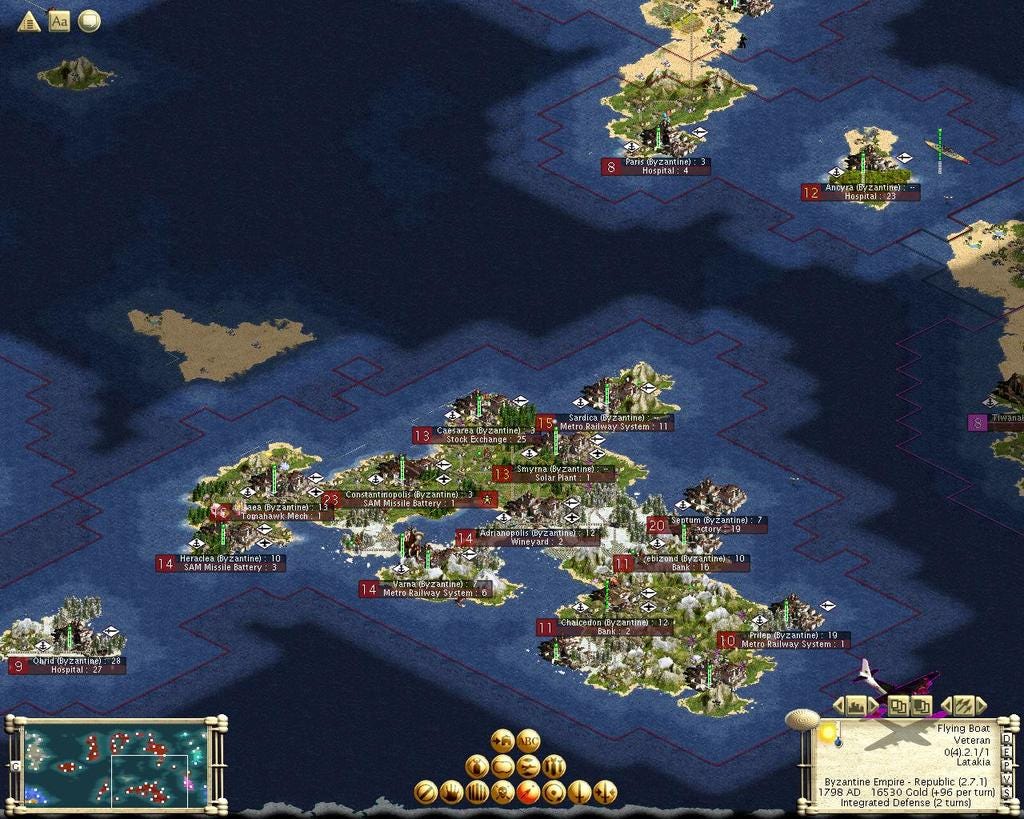
The Local on the other hand is the land of status, dominion, material possessions, charisma, sexual potency and value. It’s the competitive space where we will find Local values like Patriotism cropping up. Where the Transcendental is a domain characterised by meaning, the Local is the domain characterised by rationality.
This is a good time to point out that Peterson’s ideas of the local and the transcendental map over really, really well with Victor Turner’s distinction between Structure and Communitas/Liminality which we’ve talked about so much on The Living Philosophy. And it also maps over sublimely with Iain McGilchrist’s characterisation of the left and right hemispheres which we will be talking about in serious depth at some point I’m sure.
The Local is also known as “established territory”. In contrast with the Transcendental, the local is the known — it’s a paradigm that’s already established. It’s the readymade tablet of values handed to you by society. You’re told “here is the game here are the rules; now go win”. Get yourself a lot of money, a hot wife or husband, get yourself a big house and a nice car and be master of your domain.
In the Local you take for granted that the game works and that you want to win it. The thing is to win the game not to question it. If the Soviets or the Chinese are your enemy, you don’t go questioning this program — you take it for granted. Your role as an individual in the Local isn’t to question the value of the Local but to thrive in it.
If you’re a local Leftist you take it for granted that Fascism is the devil's own ideology, that Capitalism has destroyed human life and that the globalised Neoliberal economy is destroying the global ecosystem.
Meanwhile if you’re a local alt-right kid you take it for granted that the alphabet people are trying to indoctrinate your children; that Leftists have taken over academia as part of their devious plan to bring down Western society with their cultural Marxism; and that the Deep State is out to get you and Klaus Schwab wants to take everything you own.
Once you take these as the rules of the game you know who your enemy is, you know how to behave and you know what labels to use to keep people from straying too far from the local dogmas.
What Separates Them
This brings us to Peterson’s core argument (insofar as he has one). While most of the eight-page article is a poetic amplification of the differences between the local victor and the peacemaker, he does have a point he starts and ends with and which crops up a couple of times in between.
His argument is that what separates these Local domains isn’t simply opinions. We can call these individuals and groups living in different domains antagonists which is what they are in the Culture Wars anyway (if we think of Left and Right), or international and ideological (if we think of the Cold War distinction between Communist and Capitalist). We could also think of the distinction between the aristocracy and the republicans in the leadup to the French Revolution or the Christians and Muslims in the Crusades (or in the 21st-century “War on Terrorism”). In all of these cases, there’s an us and them and never shall the twain meet.
So Peterson is saying that these aren’t simply differences of opinion. The facts are different to these different groups:
“the basis for the disagreement is so profound that the world arrays itself differently for each antagonist.”
He goes on to say that there are an “infinite array of facts” and
“that array manifested itself only in part to each individual, or to each culture”
and that this primal infinite array:
“was filtered, idiosyncratically, or ethnocentrically, so that the world thereby derived was idiosyncratically or ethnocentrically unique – and not merely as a matter of opinion”
All of this is phrased in terms of rhetorical questions though it is clearly Peterson's opinion that this is the case given his work in Maps of Meaning. This is even more true when we come to the next part which forms the crux of his argument:
“What if was motivation itself, lurking unseen behind both vision and thought, that constructed that filter, letting in light here, but not there, and now, but not then? What if the facts would not come into alignment, between antagonists, until they wanted the same thing?”
Tangent: parallels to Peterson’s fact-worlds
There’s a lot to unpack here. But for a start, it’s worth asserting that there are a number of different angles that fit with this Petersonian idea of fact-worlds. There's Foucault’s idea of the epistemes from his 1966 work The Order of Things (l’Ordre des Choses) which is very similar to Thomas Kuhn’s concept of a paradigm from a couple of years earlier in 1962’s The Structure of Scientific Revolutions.
Essentially, Kuhn’s paradigm is a sort of bubble scientists in a certain field inhabit. Scientists working in a certain paradigm share a particular foundational worldview (a “disciplinary matrix) which orients them towards certain problems and acceptable forms of solution (“exemplar”). Science then isn’t a linear progression towards absolute truth but an evolutionary process in which we have better and better models of the world but which will always remain models.
When Einstein’s paradigm of General Relativity superseded the Newtonian paradigm it wasn’t a simple switch in which there was only addition. Something changed in that shift. The cosmos was completely transformed. Where before we had a static space in which everything ever had simply played itself out in this vast cosmic box; the Einsteinian paradigm inhabited a different cosmos in which space and time were bound up together in the famous space-time continuum. These are different universes. Something was lost.
And in the field of chemistry, the same thing happened when Lavoisier made his great discovery that oxygen was the cause of combustion. Before Lavoisier chemists proposed a hypothetical substance called phlogiston which was causing combustion. This phlogiston helped the chemists of the time model what was going on and was central to the field of chemistry at the time but with the work of Lavoisier it was lost. If you want to learn more about Kuhn’s work we made a couple of videos on it a couple of years back that are well worth a watch.
And so when Peterson is talking about different fact-worlds he’s not off with the fairies but has good philosophical underpinnings.
An even better mapover than this one with Foucault or Kuhn is with the work of economist Thomas Sowell in his book A Conflict of Visions which we also made an episode on in 2022. In this work Sowell introduces the concept of a vision which is like a sociological version of the scientific episteme or paradigm.
I’m pretty sure Peterson must have read A Conflict of Visions because his version of this fact-world fits perfectly with Sowell’s idea of a vision which he describes as follows:
“Visions are like maps that guide us through a tangle of bewildering complexities. Like maps, visions have to leave out many concrete features in order to enable us to focus on a few key paths to our goals.”
In the book, Sowell focuses on two visions that have been butting heads for centuries. He calls them the Constrained and the Unconstrained Visions. These two have fundamentally different “visions” of human nature; this leads them to completely different positions on basically every political, social and economic point.
These visions live in such different worlds that the same words mean different things to them. Sowell looks at these different usages of words like justice, equality, freedom and merit. To give just one example let’s see what he says about freedom:
“In contrast to the constrained vision, which seeks to analyze, prescribe, or judge only processes, the unconstrained vision seeks to analyze, prescribe, or judge results—income distribution, social mobility, and equal or unequal treatment by a variety of institutions, for example.”
All of this fits very neatly with Peterson’s argument in Peacemaking that:
“Ridiculous, surely: how can the facts themselves differ, when it is one world that we all inhabit? But the facts do differ, because the world is complex beyond the scope of any one interpretation”
The peacemaker

And this is where the peacemaker comes on stage.
If antagonists live in different worlds that is because they are looking at the facts in different ways and this is the root of their conflict. But to invert what he said earlier
“
ifthe facts wouldnotcome into alignment, between antagonists,until[when] they wanted the same thing”
And this is the role of the peacemaker. As Peterson puts it:
“the job of the peacemaker is to establish an accord that allows the facts themselves to become a matter of agreement.”
The various fact-worlds are simplified maps of an unimaginably complex world — crystallisations of one way of interpreting these facts. These interpretations have become fact-worlds — islands of “established territory” that have been dredged from the ocean to form antagonistic islands.
Well then, Peterson argues, why can’t we go back into that ocean — back into the Transcendental domain of the unformed primal unknown out of which all Local domains emerge — and find a greater interpretation of the facts which can bring these antagonists into the same — now expanded — local domain?
This is the exact climax that Peterson’s article ends with — the peacemaker “sees new facts” and communicates them to the antagonists and:
“The antagonists, blessed with the eyes of the peacemaker, come to see their enemies for the first time. Guided, implicitly, in this manner, they may rise above their own desire for victory, and their own subjugation to defeat, and seek peace.”
The role of the peacemaker then is to find the facts that bring peace. The majority of the article is clarifying what the characteristics and outlook of the peacemaker are. These are qualities like curiosity, courage, humility, listening, comfort with uncertainty, patience, disregard for self and status and faithfulness. The peacemaker is a citizen of no country since this would compromise his integrity (cough cough The Daily Wire cough cough) and make his success partial. The peacemaker is like a diamond — hard and yet translucent shining out of the darkness even better than light itself. And, of course, the peacemaker is a master of meaning.
Reflections
Longtime enthusiasts of The Living Philosophy will already know why I love this article so much. As I’ve spoken about before, I’ve been immersed in Leftism the last couple of years studying and writing about Continental philosophy — Semiotics, Structuralism, Foucault, Baudrillard (with a big piece on Marx and another on Critical Race Theory on the way). The reason I set off on that journey (unless memory deceives) is I got infected with Ken Wilber’s Integral Vision. And even though I’ve gone a bit cool on Integral it undoubtedly set me off on some scintillating rabbit holes.
The Hegelian/Marxian developmental pattern of Spiral Dynamics (one of the key elements of Wilber’s later work) is like psychedelics — dangerously intoxicating and to be consumed in moderation but I attribute a lot of my bug for the peacemaker vision to that. I did make a video in my early days on YouTube on Spiral Dynamics but it was an impromptu affair (one of the 100 videos in 100 days that started the channel) and in a comical move I sped the whole thing up to 1.25x speed before uploading it because I thought it was too long or I was talking too slow or something (as someone who listens to everything on 2x it took some time to figure out what a good pace was; being Irish doesn’t help).
Anyway, this hunger for peace lies at the heart of the Integral and Metamodern worldviews. Wilber talks about the food fight among a lot of these different stages and about the role of Integral as listening to the various levels and potentially harmonising them. I think a lot of the time these schools end up falling into the danger that Peterson talks about at the start of Peacemaking:
“what if the disagreement extends beyond the antagonist, to the peacemaker, who sees the facts themselves in a manner that neither antagonist can accept?”
Peterson is, as far as I know, unacquainted with Wilber’s work and after this article you can see why there was a lot of disagreement five or six years back about whether Peterson was at the Integral stage. For a good exploration of that I’d recommend David Fuller’s interview of Wilber for Rebel Wisdom.
What’s fascinating is the convergence of Peterson with the Integral/Metamodern vision and separately the convergence between McGilchrist with both.
Aside from the peacemaking vision itself — which resonates so deeply with those Integral/Metamodern sensibilities in me — something else stuck with me from this article. What screamed at me while I read it was: what the f**k happened? Where did Peterson go so wrong? How did he go from being this peacemaker travelling the strange lands of the Transcendental, seeking the facts that lead to peace to becoming the pettiest and most parochial of all culture warriors?
It’s an astounding transformation that I’ve decided to dedicate a whole other article to (I would actually love to write a play about because really what it is is it’s the story of the tragic hero exactly as Aristotle mapped it out). In that instalment, we’ll be exploring this Petersonian arc of the tragic hero and compare it to some fantasy and sci-fi stories I love from Brandon Sanderson (Mistborn) and Frank Herbert (Dune).
JBP really did help me immensely. But consider how abstract and groundless these mythological allusions are. Consider how Marshall McLuhan (another prairie-province Canadian at U of T who became world famous) said much the same thing in The Gutenberg Galaxy, but actually placed it historically and materially, while explaining the mythic, allusive nature Peterson relies upon:
> In accordance with Pope's prediction of automatic trance or “robo-centrism,” Smith declared that the mechanical laws of the economy applied equally to the things of the mind: “In opulent and commercial societies to think or to reason comes to be, like every other employment, a particular business, which is carried on by a very few people, who furnish the public with all the thought and reason possessed by the vast multitudes that labour.”
> Adam Smith is always faithful to the fixed visual point of view and its consequent separation of faculties and functions. But in this passage Smith does seem to sense that the new role of the intellectual is to tap the collective consciousness of "the vast multitudes that labour." That is to say, he intellectual is no longer to direct individual perception and judgment but to explore and to communicate the massive unconsciousness of collective man. The intellectual is newly cast in the role of a primitive seer, vates, or hero incongruously peddling his discoveries in a commercial market. If Adam Smith was reluctant to push his view to this point of the transcendental imagination, Blake and the Romantics felt no qualms but turned literature over to the transcendental arm. Henceforth, literature will be at war with itself and with the social mechanics of conscious goals and motivations. For the matter of literary vision will be collective and mythic, while the forms of literary expression and communication will be individualist, segmental, and mechanical. The vision will be tribal and collective, the expression private and marketable. This dilemma continues to the present to rend the individual Western consciousness.
Peterson has to be either a scientist or a mystic—there is no in-between which is grounded in historical or material reality absent which can be abstractly synthesized without recourse to many, many, many, many specific references. One must be encyclopedic to escape mythic allusions.
Great article....Jordan Peterson and Sam Harris are two intellectuals who well demonstrate how tricky intellectualism can be!