

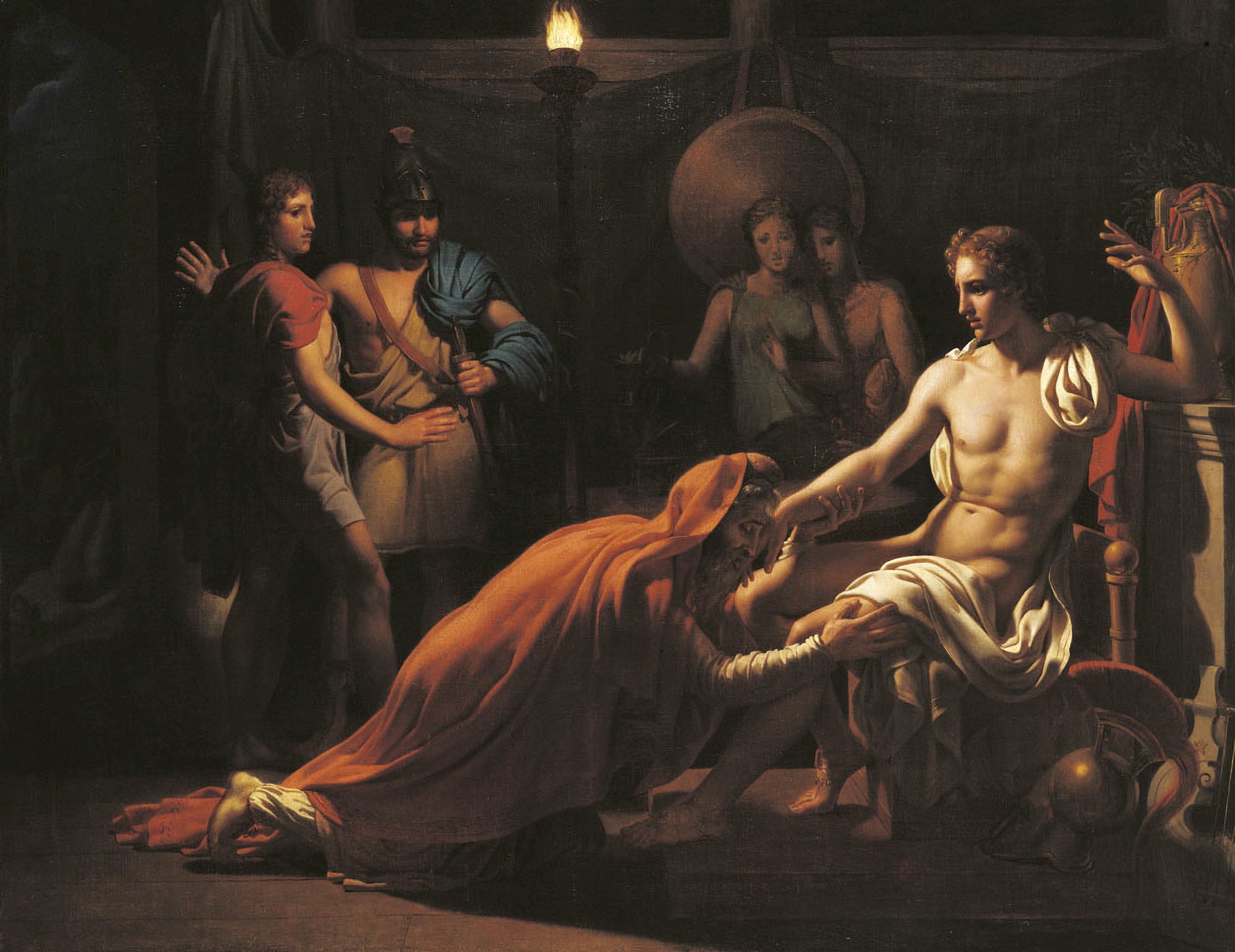

I think this week’s piece was the first poem I ever memorised of my own volition. It’s by Northern Irish poet Michael Longley, who was on the Leaving Cert English syllabus when I was in school. I think Yeats and Kavanagh were the poets my teacher steered us towards, but perusing the rest of the book, I remember reading this and being knocked with the force of a cannonball.
The content of the poem is from our oldest piece of literature in the Western canon: Homer’s Iliad. But in context, it’s about The Troubles in Northern Ireland and the brutal cycle of senseless violence where revenge killing repaid revenge killing. It’s what René Girard calls a mimetic crisis — in which the cycle of horrors symmetrically mirror each other until the root is left irrelevant. A Catholic killed a Protestant, so Justice necessitates the killing of another Catholic. When the victims are innocent — people selected purely on a contingency of their identity — how can we possibly forgive? How do you move past that? I struggle to let a petty argument go without getting the last word in. What tragic, titanic wisdom it must take to move past that kind of wounding?
Longley’s hope is sublime; it’s the lofty peak of human ethics. The consonance between the content and context — the oldest piece of literature and contemporary conflict — reminds us that these problems are as old as time. It’s a reminder that, unlike the skyscrapers of knowledge that science has accumulated over the centuries, the work of wisdom begins again with each new generation and each new birth.
Given the way of humans and the world, it seems miraculous every time the hatchet is buried, slate wiped clean, peace reborn from the ashes of tragedy.
I remember, in my youthful days, a medieval mystical work called The Cloud of Unknowing, in which the (unknown) author talked about the process of illumination: you enter the darkness — that pitch cloud of unknowing. This, you can do by your will. What you cannot control, what you can only pray for, hope for, and be blessed enough to receive, is the divine light which can fill that darkness. You can empty yourself, but only by the Grace of God can you be refilled.
That, it seems to me, is the nature of forgiveness. You can’t scale it; you can’t bottle it; you can only move in its direction. There’s tragedy in that. The gravity of human nature makes it so much easier to perpetuate the cycle of misery. Justice seems to demand it. But sometimes, miracles happen.
Ceasefire by Michael Longley
I
Put in mind of his own father and moved to tears
Achilles took him by the hand and pushed the old king
Gently away, but Priam curled up at his feet and
Wept with him until their sadness filled the building.
II
Taking Hector's corpse into his own hands Achilles
Made sure it was washed and, for the old king's sake,
Laid out in uniform, ready for Priam to carry
Wrapped like a present home to Troy at daybreak.
III
When they had eaten together, it pleased them both
To stare at each other's beauty as lovers might,
Achilles built like a god, Priam good-looking still
And full of conversation, who earlier had sighed:
IV
'I get down on my knees and do what must be done
And kiss Achilles' hand, the killer of my son.'
In another poem, a defeated king named Dhritarashtra embraces the killer of his son.