

Names for concept: stocks and flows
Origin of Concept: Systems Thinking
Where it’s popular: Systems Thinking
Useful for: understanding how systems change and evolve
“A system is an interconnected set of elements that is coherently organized in a way that achieves something.” (Meadows 2009:11)
In last week’s Philosopher’s Toolkit, we looked at Donella Meadows’ map of a system in three parts:
Elements — the things
Interconnections — the relationships and flows between the things
Function/Purpose — what the whole system is pointed towards
This week, we’re looking at the next tranche of systems concepts in Meadows’ systems thinking: stocks and flows.

[side note: the clouds in the diagram basically signify the parts of the process that are bracketed out. We’re not looking at where the inflows or outflows are coming from/going to; we’re just focusing on a particular part of the process here.]
In a nutshell, a stock is a type of element, and a flow is a type of interconnection. So we’re still playing within the same map of the system. Only we are looking at the dynamic movements of a system over time.
Stocks and flows — along with next week’s topic, the feedback loop — capture the rise and fall of systems.
Stocks
A stock is a type of element representing accumulated quantities. They are:
“a store, a quantity, an accumulation of material or information that has built up over time … the elements of the system that you can see, feel, count, or measure at any given time” (p.17)
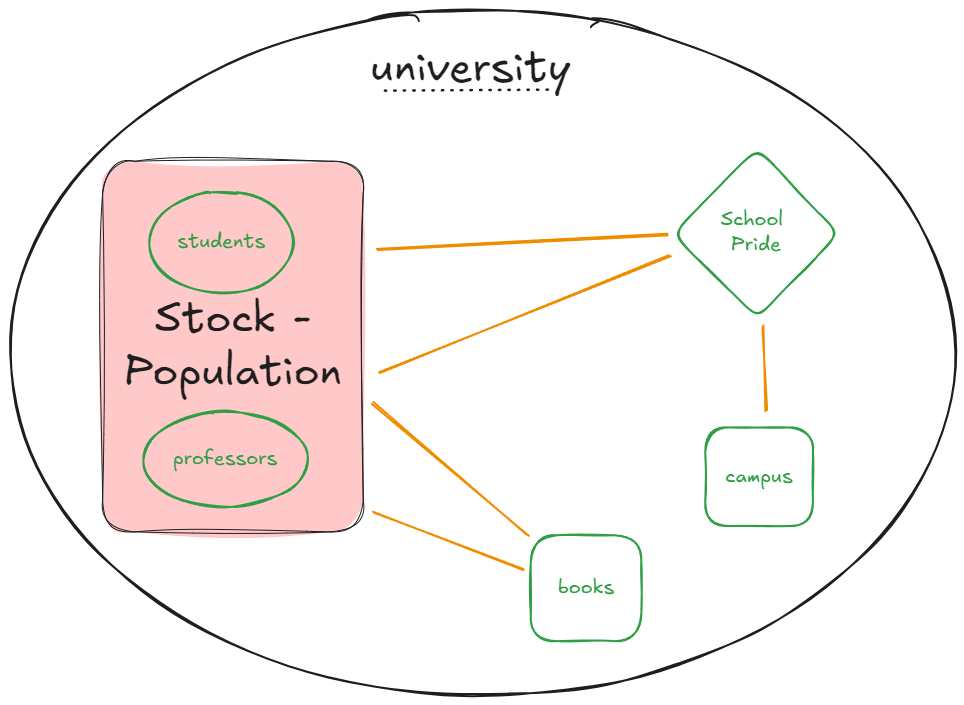
In the university system, you have a number of stocks, for example, the population of students and professors.
A stock isn’t an individual element like this student or that professor, or that building. It’s an accumulation of elements. In this example, it’s the population of students and/or professors taken as a whole — as an accumulation — that make up the population of the university.
Flows
A flow is a type of interconnection. Flows pour in and out of the stock over a period of time.
To return to our university example, the population stock has a number of inflows and outflows. There are student admissions and hiring as some of our inflows, and retirements, firings and graduation as our outflows.

The stock rises and falls with these inflows and outflows: more admissions and hiring, more stock and vice versa.
The balance of these inflows and outflows with the stock causes a couple of types of feedback processes. These feedback loops are what we’ll be looking at in the next Philosopher’s Toolkit.
What a wonderful article. This is especially good for someone who does not know Donella Meadows.