

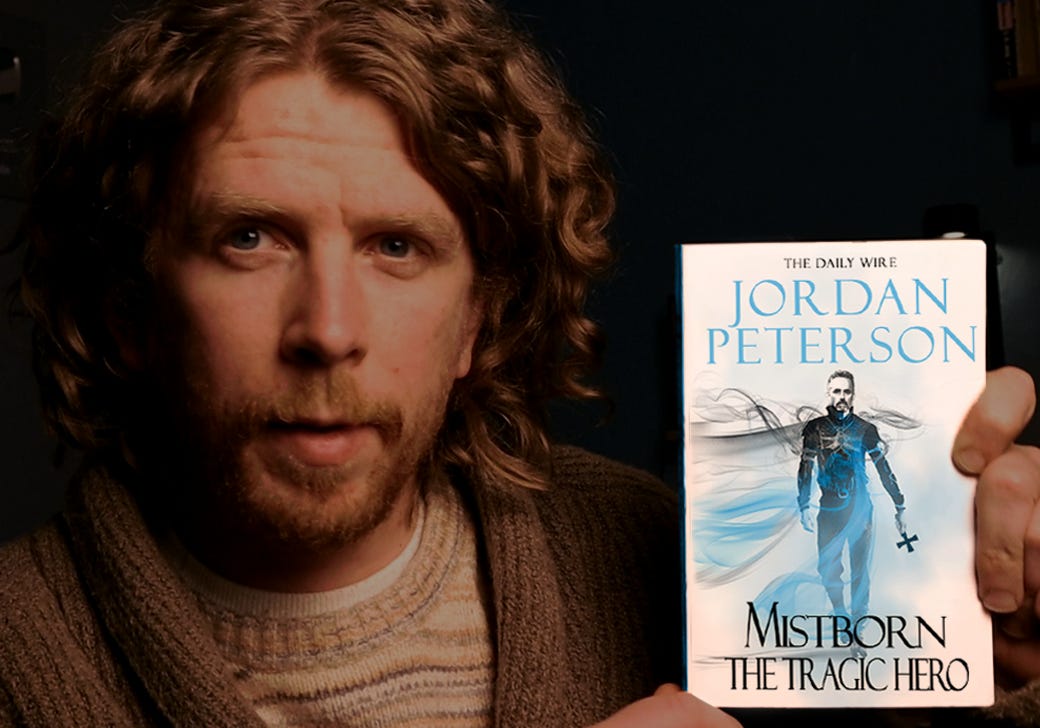
This instalment is essentially an elaborate nerd out on Jordan Peterson and fantasy author Brandon Sanderson’s first Mistborn trilogy. If you’ve never heard of Brandon Sanderson and you don’t care about Peterson then you’d be forgiven for thinking you won’t care about this article. But you’d be wrong (probably).
This article is about a 21st-century tragedy that we’ve seen play out before our eyes; it’s a story of power and love; it’s a story about hubris and how the best intentions and a wise philosophy aren’t enough to protect us if we walk in strange lands where angels fear to tread. Above all this is a cautionary tale about a tragic hero whose heart wasn’t strong enough to withstand the corrupting dangers of power; it’s a warning to us all that even if we are armed with the wisest philosophies we can still become that we fear most. As Nietzsche put it:
“Whoever fights monsters should see to it that in the process he does not become a monster. And if you gaze long enough into an abyss, the abyss will gaze back into you.”
In this article, I argue Jordan Peterson stared a little too long into the abyss and he went a bit nutso.
This whole vein of thought was prompted by the subject of the last article — my recent obsession Jordan Peterson’s essay from 2005 called Peacemaking Among Higher Order Mammals. It is one of the strangest things you’ll ever read with lines like:
“The truly idealistic man is an avatar of the reality of the unknown, and not a loser masquerading in moral dress.”
and
“To become an advocate of the damned, the peacemaker must abandon his local pretensions, and his desire for status. Otherwise he cannot listen. But if he serves an advocate for the damned, then he risks developing sympathy for the devil himself.”
It’s somewhere between Nietzsche’s register in Thus Spoke Zarathustra and an angsty teenager imitating Nietzsche and I love it. Probably because I know it’s Jordan Peterson. I suspect that if the reputation of the writer wasn’t so well-established there might be a cringiness to it that would interrupt enjoyment.
Summary of Peacemaker
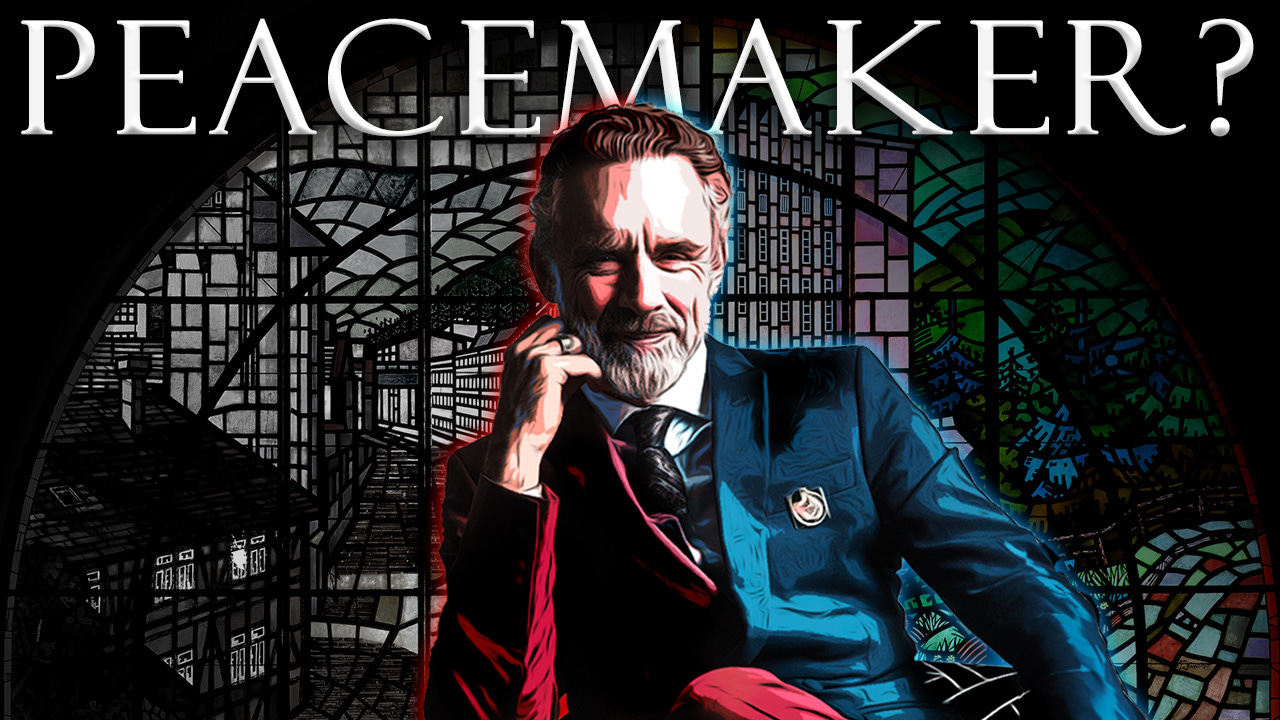
I talked about what I loved about the essay last time. For those of you who didn't read that article, Id highly recommend checking it out. The basic summary is something like this: Peterson is trying to identify the characteristics of what he calls the Peacemaker.
To do this he distinguishes between two domains: the Local and the Transcendental. You can think of the Local as islands of Petersonian Order in a Transcendental ocean of Petersonian Chaos. The Local is the domain of competition, hierarchies, status, sexual attractiveness and dominance. The Transcendental on the other hand is the place beyond where neat distinctions break down — it’s the unexplored land of concepts and worldviews waiting to be born.
Longtime readers will easily make the connection with Victor Turner’s idea of Structure with this description and as we’ll see the Transcendental fits very neatly with Turner’s idea of Communitas all of which we talked about in the liminality arc of articles.
The person who is most successful in the local is called — drumroll please — the local victor. The local victor is the opposite of the Peacemaker who is associated with the Transcendental. But Peterson doesn’t just contrast the Peacemaker with the local victor but with the local loser — who the Peacemaker kind of looks like but very much isn’t according to Peterson.
So just to summarise so far we have two domains the local and the transcendental and the archetypal figure associated with the local is the local victor (and also the local loser) while the figure associated with the transcendental is the Peacemaker.
The way of the local victor is to beat out the others — it’s a sort of zero sum game in which there can only be one winner. The Peacemaker however is curious, humble, uncertain, lacking axioms, deeply moral and unconcerned with his own status; the Peacemaker holds no grudges but is also hard, adaptable and always at war. He is not associated with any side — he’s a citizen of no country — and so he has nothing to gain by any side winning. He is a creature of the transcendental no-man’s land. His quest is to bring peace — is to find the facts that bridge between these groups and thus through a shared understanding of the world bring peace.
Now as I was saying in the last article I love this — this captures the exact spirit of what I aspire to do (even if I don’t agree with all of Peterson’s particulars). But what I love about this piece is the contrast between the aspiration contained in this essay and what Peterson has become. It really makes the whole Jordan Peterson journey into a tragedy of a once noble heroic protagonist who becomes what their original self promised they wouldn’t — the villain. His progression from aspiring Peacemaker to twitter-raging Daily Wire host — which you can even see in his appearance over the years where he looks more and more like the evil villain [show progression of Petersons from first Rogan appearance through to Daily Wire then doctor evil] — this progression fits almost perfectly with Aristotle's description of the tragic arc which Chelsea Hogue has summarised as follows:
“Aristotle defined a tragic hero rather strictly as a man of noble birth with heroic qualities whose fortunes change due to a tragic flaw or mistake (often emerging from the character’s own heroic qualities) that ultimately brings about the tragic hero’s terrible, excessive downfall.”
— Chelsea Hogue, “Tragic Hero.”
In light of all this, Peterson becomes a tragic hero — a cautionary tale on how the right philosophy and best intentions don’t guarantee protection from the corruption of power. And that is where Mistborn comes in.
Mistborn
I’m a big fan of Brandon Sanderson. It took a few years of badgering but my friend David finally convinced me to read the Stormlight Archive a few years back. As I feared, I lost a month of my life to the fevered obsession to know where the story was going. I cannot be trusted with great stories (especially ones with 1.7 million words in them).
Anyway, Mistborn is another series set in Brandon Sanderson’s “Cosmere” universe. For those of you who haven’t read them they are amazing and I am sorry but you must either stop reading right now or be subjected to some appalling spoilers. You have been warned.
The metaphysical backstory of the Mistborn world is that it was created by two gods called Ruin and Preservation. Ruin is a god of destruction who loves death and entropy and all things coming to an end while Preservation loves life and the continuation of life and dreams of the eternal endurance of all things. Now these gods, understandably enough, hate each other. But each has something the other lacks and their dreams are symmetrical. Without Preservation, there can be no life for Ruin to destroy; without Ruin, Preservation’s life would stagnate and cease to be life.
And so, they need each other and work together to create this world to fulfil their respective dreams but it’s a treacherous alliance from the start with each trying to outwit the other — Ruin trying to destroy everything and Preservation seeking to free life from the doom he agreed upon with Ruin.
When we enter the story with the first book, the world of Mistborn is basically a horrible fantasy dystopia. It takes place in a world covered in ash which has to be continually swept away or it piles up and piles up which outside the cities and plantations is exactly what happens.
It’s a world where at night everyone has to stay indoors because the entire land becomes covered in a dense mist which is rumoured to contain monsters and kill. This world is ruled by an evil emperor figure called the Lord Ruler who is immortal and unbelievably powerful and just as unbelievably tyrannical. Society is rigidly hierarchical with the Lord Ruler on top, then his nobility and then at the bottom the masses of the lower classes called the Skaa.
The Lord Ruler has ruled this empire for a thousand years and is essentially a god to his people who all fear him. There’s a religious cult around the Lord Ruler that portrays him as a divine saviour of the people from a vague evil called the Deepness which he defeated a thousand years before the first trilogy begins. This religion is a means of population control since what’s the point in attempting a revolution against an immortal all-powerful god.
Essentially the Lord Ruler is an evil piece of shit who in the first book you love to hate. But as we learn in the first trilogy this picture is a little simplistic and this (after an excessive amount of exposition) is where the map-over with Peterson takes shape.
As it turns out the Lord Ruler was once a good man with good intentions which is really hard to believe in the first book. Before he was the Lord Ruler he was a man named Rashek who was part of a quest to find something called The Well of Ascension that could help save the world then in trouble from the mysterious menace of the Deepness (associated with those pesky killing mists).
Rashek ends up killing a man who is well-intentioned but misguided and taking the power himself. With it, he has all the power of the god Preservation with the caveat that the power only lasts a few minutes. Rashek’s intentions in taking this power are pure and wise and in the few minutes with this divine power he tries to save the world from the Deepness.
He moves the planet’s orbit closer to the sun hoping to burn off the mists but this only ends up scorching the land and so he creates volcanos to suffocate the land in sulphur thus cooling the land and preserving it. Hence we end up with an ashen barren landscape where life can barely survive. He seeks to preserve the people as much as possible and protect them from Ruin and so he ends up creating the rigidly hierarchical dystopian society with the vain opulent nobility and the oppressed downtrodden Skaa.
Rashek starts out with the intentions of a peacemaker. But in the end he becomes a tyrannical vengeful man who preaches Order and fears Chaos. And in all of this tyranny and misery he has wrought, he still sees himself as the good guy who just happened to have to make a few compromises along the way.
The brilliance of Sanderson’s writing is that we can see his point of view. The Lord Ruler thinks he’s preserving the world — he wishes things had turned out better and hopes he can fix them but in the meantime, he justifies his descent into tyranny as a necessary move. He is the hero that his people need even if they don’t appreciate it.
The Mapover with Peterson
This is Peterson. He sets out in his early career with Maps of Meaning and Peacemaking on a quest for a Transcendental Peace. He had a higher calling. He was a creature of no-man’s land. As his pre-Lord Ruler self wrote:
“[The Peacemaker’s] journey must be directed by something that beckons from far above the horizon. If the scene shifts, and new mountains arise where only plains existed before, he must have set his vision high enough so that the stars can still be seen. He must therefore have seen the stars that beckon beyond the mountaintops of his own home, so that he can recognize them when he is a stranger in a strange land.”
But Peterson today is no stranger in a strange land. He has no higher stars orienting him. As we’ll be looking at in the article on how Twitter is a force of evolutionary regression — driving us out of the prefrontal and into the limbic — Peterson’s mind has been addled by war. He has lost his way.
“The peacemaker must therefore be the man without a country a citizen, as it were, of no man’s land. If he is not, then he desires the brokerage of peace in a foreign land as a feather in his cap, or a scalp on his belt. He wants to bring peace, to increase the possibility of victory and stability in his own, local environment, and not to serve as a mediator between the transcendent and the local, at unspecified cost to himself. There is no reason to trust such a man, and he will not see the obvious, when seeing the obvious becomes necessary”
Compare this with The Daily Wire host spewing hatred against the Woke Left on X.

Peterson is now a local victor selling out auditoriums and hosting his own lucrative show on The Daily Wire just like a good local victor. But as the good book says “ye shall know them by their fruits” and the fruit of Jordan Peterson is not love and understanding, is not peace but hate and polarity. He was a well-intentioned Rashek but now he is a tyrannical Lord Ruler suffering from all the pathologies of Order that he once so wisely warned about.
There is no doubt that he has helped a lot of people with their mental health I don’t think anyone can take that away from him and he has had an empowering impact on a lot of people particularly young men’s lives. In that, he has been successful. But it’s worth reminding ourselves that if we go back to the days of Maps of Meaning in 1999 and the Peacemaking essay in 2005, this wasn’t Peterson’s main quest. He wanted to be a peacemaker. And he failed.
Or maybe he didn’t. The thing is, if we think of what peace Peterson felt needed to be made at the time then it may have been more about building a bridge between modernity and traditionalism. The New Atheist movement really got going around the time of the Peacemaking essay so perhaps this was the peace that Peterson had his eyes on. In that case, his conversations with Sam Harris could be seen as the fulfilment of this arc. It would also explain the blatant contradiction between the peacemaking goal and his status as a local victor in the Culture Wars of the Naughteens.
In any case, to dismiss Peterson as so many liberals and leftists tend to do as always being a bad egg is to miss the deeper lesson in Peterson for us and that is the warning of the tragic hero. For me, Peterson is the cautionary tale. While I have no intentions or expectations of a fame like Peterson’s the thought of it scares me.
This article could just as easily have been about Dune and the tragic hero of Paul Atreides [WARNING: post Dune 2 spoilers incoming]. The words of Chani to Paul come to mind:
“I will love you as long as you are you”. [or something like that]
Like Rashek and Peterson, Paul is a tragic hero who loses his way; like Rashek and Paul Atreides, the irony of Peterson’s journey as a tragic hero is that he was the very person preaching against this danger. Rashek killed another man and took the power out of a desire to protect where the other man would have made things worse; Paul sends the galaxy into holy war to prevent a worse evil; and Peterson became a lightning rod of the Culture Wars because he wanted to be a Peacemaker.
I think these dangers can all be understood — as we’ll explore in a future instalment — as the dangers of high serotonin which, in making us local victors, strips away our humility (a quality of the Peacemaker) and flattens us into belligerent local victors who have forgotten their quest. Peterson has forgotten the value of liminality and that is a tragedy for a man who once sang the praises of the Transcendental no-man’s land that ultimately surrounds all the islands of the Local.
Hi, I’m really curious about your article, but I’m about to start reading the Mistborn saga. Does the post contain any spoilers for the books? And can it be read without having read Mistborn?
I enjoy reading your perspective on Jordan Peterson’s journey or his struggle between the local and transcendental realm. Noticing some of these patterns you described, I used to ask myself if toying with his dark self is not necessary to wholeness. I wonder how can one be truly a peacemaker without overcoming its own propensity for crime (metaphorically). But part of me, is also is asking if he’s not over the line. Or where does a « good » man put his darkness?