

I found this week’s reading a bit slower going. The systems zoo, while interesting, was a bit tedious. Though I must admit, the opening quote was 👌👌
“The . . . goal of all theory is to make the . . . basic elements as simple and as few as possible without having to surrender the adequate representation of . . . experience.”
—Albert Einstein
The animal that stuck out to me in her zoo was population. Probably because Meadows was the author of Limits to Growth and was part of the great Malthusian fear-mongering of the Population Bomb/Club of Rome subculture of the late 60s/early 70s. It’s one of the many historical curiosities about Meadows’ work. How things could have turned around so much in 50 years, where instead of worrying about insane overpopulation, we are staring demographic collapse, is a delectable systems curiosity. Looking back, you can already see the fertility rate collapsing when they were writing. Though the stock was continuing to be fed by the inflows, the trajectory of fertility was already on the wall. The increased life expectancy and decrease in child mortality was like the sulphur dioxide emitted by the great shipping containers: a mask.
Since the great pollutant of sulphur was cut out of the world of shipping a couple of years ago, the world experiences less acid rain but also a 0.05ºC increase in temperature. The sulphur masked a deeper problem.
The same thing was going on with breakthroughs in medicine hitting the Global South: a massive increase in population by eliminating the outflows. But this was merely a mask over a deeper trend: the precipitous decline in inflows. The past 50 years have not been good:
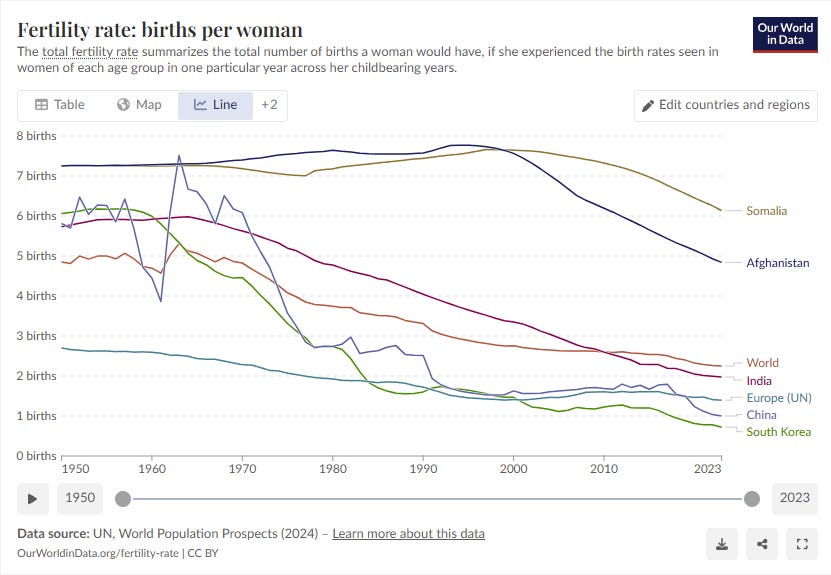
The trend lines all point one way. The world is barely holding on above the replenishment rate (2.1 births per woman) at 2.3, meanwhile South Korea is down to 0.7, and China is at 1.0, which is…not good. Instead of explosion, population implosion seems to be the imminent threat (unless some other balancing feedback loop enters the fray).
Anyway, that’s egregiously tangential except perhaps as an illustration of how delays in changes in stock can outwit even the savviest systems thinkers. It was something I wrote a lot about in a long piece I was working on last year on The Tragedy of the Commons before I discovered Ostrom’s Nobel-prize-winning work on commons and postponed publishing (indefinitely it seems) pending further research.
Back to the book. In the systems zoo, she looks at a number of different species of systems:
One stock systems
A stock with two competing balancing loops
A stock with one reinforcing loop and one balancing loop
A system with delays
Two stock systems
A Renewable Stock Constrained by a Nonrenewable Stock
Renewable Stock Constrained by a Renewable Stock
And that was the chapter on the systems zoo. Kind of technical, helpful for giving some flesh to the bones of some of these concepts, but nothing that got me excited.
Then, in the third chapter, we got some more concepts:
Resilience
Self-organisation
Hierarchy
All of which put me very much in mind of Ken Wilber’s work (particularly Sex, Ecology, Spirituality). I think Wilber captures the hierarchy element better than Meadows. The idea of a “holarchy” — of holons (wholes that are also parts — the subsystems within subsystems with subsystems) is better, but that may be because he maps out the nested levels of holons/subsystems so well. The Nordic Metamodernists also talk a lot about all this, which is unsurprising given their Wilberian DNA.
Next week's reading: "THREE: Why Systems Work So Well" and "FOUR. Why Systems Surprise Us" (pp.75-110)
Applying this books concepts to human behavior has been kind of a revelation to me. ESP in identifying and seeking positive feedback loops for myself and avoiding negative ones.