


My week of dopamine fasting turned into a bit of a nerd fest.
Instead of a week of tranquil meditation, it turned into a week of unorthodox doing. My brain’s Task-Positive Network (TPN) is a bit more stubborn than initially suspected.
There were moments of pure beauty — running in the forest with my friend David and Biblical rain bucketing down upon us, and the sunset riverbank walk on Wednesday, you see above. But on the whole, it wasn’t quite as much sitting staring at the wall as I’d fantasised (though there was a bit of that earlier in the week).
I didn’t watch movies, TV or YouTube, I didn’t pick up any books, or get stuck scrolling on my phone or doing busy work. But my TPN found unexpected ways to tempt me. I spent hours playing around on guitar and learned a new song (the version of Shoals of Herring from Inside Llewyn Davis — lovely tune (and soundtrack in general)). I stumbled on a scrambled 5x5 Rubik’s cube (some noodling visitor thought they’d try their hand at it, I guess) on Tuesday evening and spent about 6 hours in pure flow trying to solve that on Wednesday (ultimately, of course, I was successful).
NotebookLM
The real TPN playground of the week, however, was AI. In catching up on my deluge of read-it-later articles recently, I’d read about Google’s NotebookLM — an LLM designed not to hallucinate. It relies mainly on its short-term memory (the information you give it) rather than its training data. Where Claude has an impressive context memory of ~150,000 words (and ChatGPT’s ~100,000), NotebookLM’s memory is ~25,000,000. That’s a lot. The paid version goes up by another order of magnitude to 250 million words.
Curious, I began to dabble. I created a project with Jung’s Collected Works and it was able to answer questions I had and direct me to specific references within the works. Here’s an example from a question about Jung’s theories of dreams:
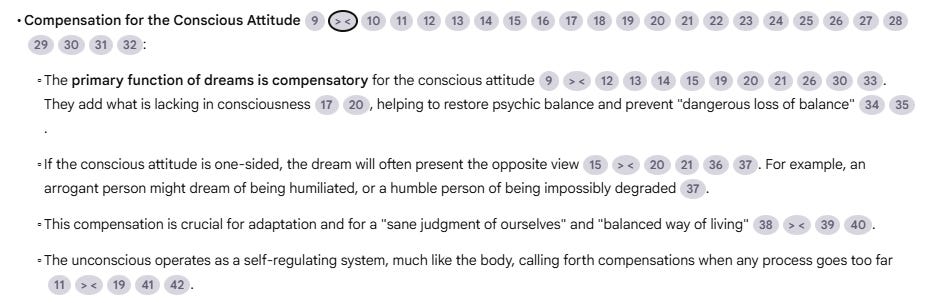
Each of these numbers are references to specific places in Jung’s books 🤯. For future projects involving a lot of research, this is going to be a game-changer. I spend an awful lot of time tracking down things I already know or searching for where an author talks about a certain thing. This is going to eliminate a lot of that time-wasting, so I can cut right to the juice of knowledge-making.
Context Engineering
I also watched a video another friend sent a few weeks back by Tiago Forte about “The Master Prompt Method”. This is part of the current phase of AI chatter. AI discourse has a lot of these phases. There was a whole doolally about Prompt Engineering in the early days of mainstream AI, then there was that recent hoo-ha about the sycophancy of AI models, and most recently we’ve had talk of the importance of Context Engineering. That’s where this video fits in.
The idea is that the LLM needs context to know what kind of answer is the right kind of answer. There’s so much implied in context and this needs to be articulated to get the best response from the AI (Wittgenstein would be so proud). The idea then is to create a Master Prompt that you feed to your pet AI every time which tells it everything about your work context.
This week, I spent a day working mine out. I still need to add in more personal and educational stuff (regarding my upcoming part-time Jungian Master’s in September). I haven’t done much testing with this prompt yet so I can’t much speak to its efficacy, but if it makes the centauric process more fluid, then it’s worth experimenting.
Vibe-Coding
So, contrary to expectations, I was having a very nerdy Rubik’s AI week when I sat down at my desk yesterday morning with great intentions for doing some thinking. After some scintillating conversations with Simeon (of Seeker to Seeker fame), another friend and my brother over the previous 36 hours, I sat down to do some thinking in my Obsidian Zettelkasten note-taking system and immediately ran into my digital Zettelkasten pain point: I get lost in the numbers. As I’m scrolling through, and I’m on note 5301.1.2.1.1.2b1a.1, I can’t quite remember what the branches above (e.g. 5301.1.2.1.1.2 or even 5301.1.2.1.1) are about. I’m deep down a rabbit hole, and it takes time to figure out the context.
Of course, this is part of what the OG polymathic Zettelkastenner Nikolas Luhmann touted as a feature more than a bug. This friction is the spark that gives life to the system. By travelling the system’s high roads and byroads, and familiarising yourself with the landscape of this emergent complex thing, he found that after a few years it was living; it had become a second mind. Note: not just a second brain, not an extension of his brain in the way that a smartphone is: a second mind. His experience of the Zettelkasten was more like conversation than the addition of papers to an accumulating, dead pile of thoughts.
But, being a citizen of the 21st century, friction reduction is in my nature.
So it was, on a Saturday morning, that I, lover of maps, fantasised about a map that could help me navigate around this system and get to the nearest siblings, cousins, aunts/uncles, and grandparents to get a better eye on the context. This is where the paper thinking system is better: it’s easier flicking through a deck of paper — and more tactually satisfying.
This put me off the digital system last year (or maybe it was the year before; tempus fugit). I keep coming back, yet I never stop pining for this context creator. I reckoned a plugin for Obsidian would be amazing but there was so much exploration and tinkering to be done to figure out what would work that I wasn’t comfortable asking my coder people for a favour or paying for someone to do it.
But yesterday morning, I remembered: we live in the age of vibe-coding. And I have a Claude Pro subscription at the moment. So I decided to try being a coder for the day (albeit merely a vibe-coder).
I have to say: it was mind-blowing.
Much like the Rubik’s cube, the process engaged the problem-solving, puzzle-loving part of my brain. I was overloaded with dopamine again. How can we change this? How can we change that? Let’s Change the colours, change the size, animate the text, give me sliders for depth, sliders for branching, why are some nodes showing up miles off to the side? show me grandparents, aunts/uncles, separate the type of children notes, change the hover colour, why are those two nodes overlapping? make it so when I click on it it opens that note in the same tab and so on and on and on. Hours burned away. The only reason I stopped at all was that I maxed out my Claude usage (three times) which meant I had to wait a few hours to get back to it.
In the end though, I have a working Obsidian plugin that I’ve created a GitHub repository here and submitted it to become an Obsidian Community Plugin (apparently this can take weeks or months). The demo below will give you a basic idea (as well as having some interesting insights into last year’s deep dive into consciousness). Most importantly, I have a way of getting around my digital Zettelkasten system.
Not bad for a day’s vibe-coding.
So, not quite the week of Pascalian wall-staring I had in mind for my week, but my mind is nourished with new tools and possibilities, and I did cut down my passive consumption a lot. I’m going to try again this coming week and see if I can find that inspired contemplative mindset of the philosopher once again.