

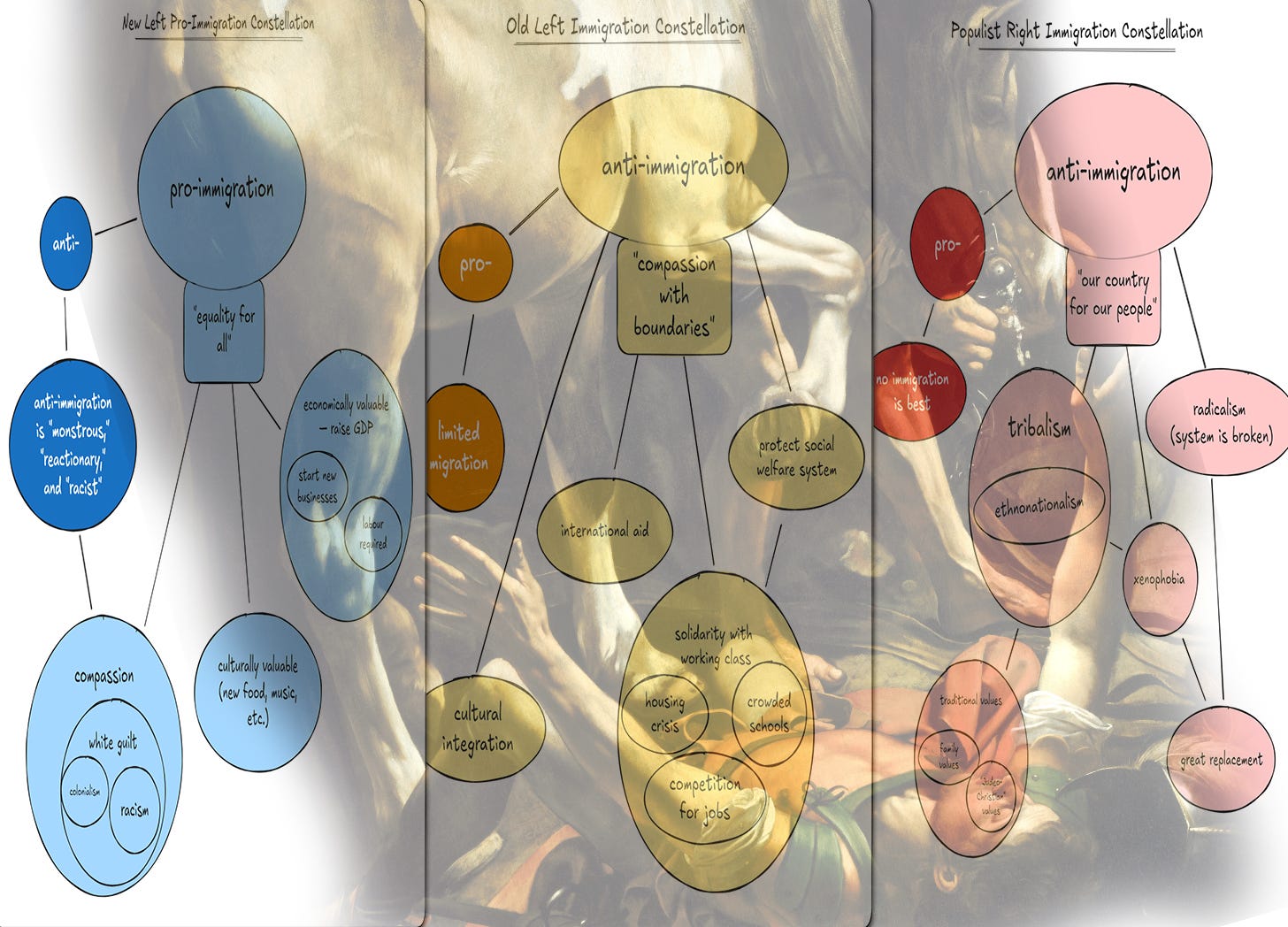
When it comes to immigration, you probably think there are two camps: pro-immigration and anti-immigration.
I did.
I was wrong.
The Populist Right position
Immigration has been the big story in Irish politics the past couple of years. Throughout this time, I’ve been having arguments with a close friend of mine who is all-in on the anti-immigration side.
In that time, we got as far as agreeing there was a problem. Naively, you would think this would resolve our differences. But, despite our agreement on immigration levels being too high, we couldn’t seem to agree on anything else.
Perusing the online Irish anti-immigration discourse, I didn’t feel vindicated or fired up. Instead, I felt only that tangle of knots you get when your faith in humanity gets shivved in the gut.

I couldn’t stomach the anti-immigration subcultural discourse because I found so many of its tropes so goddamn off-putting. Their retort, of course, is that the reality is ugly, and they are merely shining a light on a nasty problem; and if you think we’re bad, you should see the other guys; and if you don’t listen to us moderates, then you’re going to have to deal with the extremists (Jung’s concept of the Shadow is written all over this one).
Despite such overtures, I was not inspired.
The Populist Right anti-immigration constellation
After the Philosopher’s Toolkit on clusters and constellations, I decided to sketch out the cluster of beliefs that make up this subculture, and here’s what I came up with:
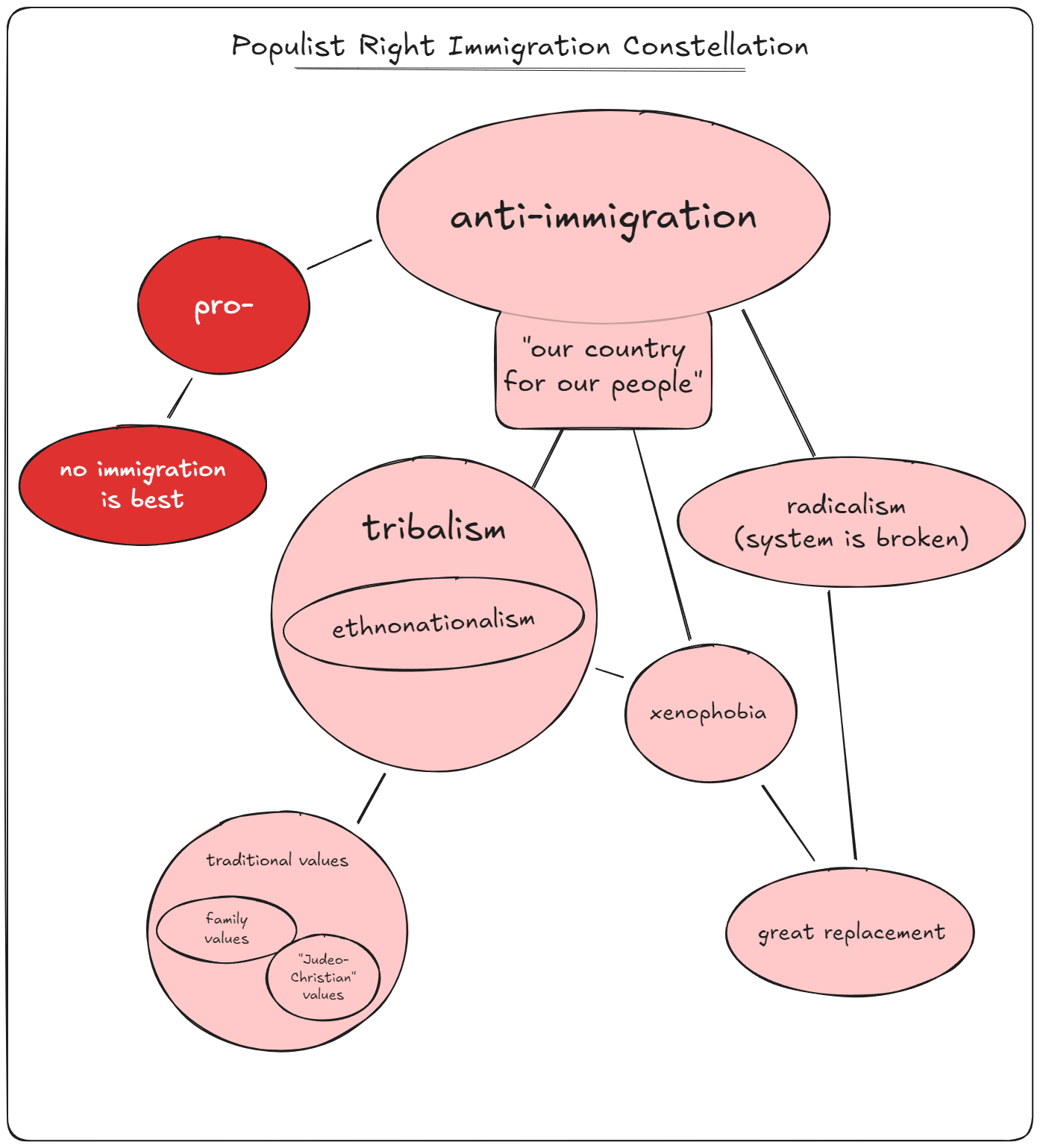
Radicalism For a start, we’ve got our classic radical rhetoric: anti-establishment, anti-elites, fuck the man, drain the swamp, etc. There’s a lot of government bashing going on; trust is not high.
Ethnonationalism/Xenophobia As well as radicalism, we’ve got the us/them tribalism/xenophobia dynamic at play. There’s a major emphasis on crime, Islam and attacks on women in this subculture1. The deeper you dive into the mire, the more intensely ethnonationalist it gets. Demographics inevitably come up, and fears about Irish people being outnumbered in their own country within a generation (or two) — which is where the Great Replacement meme rears its head.
Pro-Immigration stance Opinions on the ideal amount of immigration varied. Beneath a general vibe of “the best immigration level is zero”, I got the sense that small numbers of immigration would be acceptable (though this position seems rarer). In America’s case, the populist tech-right believe in highly skilled immigration.
the baby in the bathwater
“No matter how thin you slice it, there’s always two sides”
As with anything involving adults of sound mind, for such a constellation to be compelling, there has to be a pebble around which the ideology snowballs.
In this case, the vibes of the establishment here in Ireland are as typically pro-immigration as the rest of the liberal West. We had a minister send out a tweet welcoming immigrants to Ireland (in six languages, no less) — a friendly move that has not been forgotten2.
Also, integration of large numbers of immigrants isn’t as straightforward as the pro-immigration camp makes out. Even Sweden, the Valhalla of liberalism, has had to clamp down on immigration in recent years, because of a surge in gun crime and gang violence in which immigrants are disproportionately represented. Germany has experienced similar struggles.
There’s a reason why populist parties have surged across the West. Hence, the Shadow constellation of the anti-immigration Populist Right has taken shape.
The other side of the coin
Meanwhile, in the blue corner, we have the other mainstream immigration stance. This is the pro-immigration stance of polite society — the one you’re allowed to voice in public. This is the narrative that has attained memetic hegemony in the past 15 years:
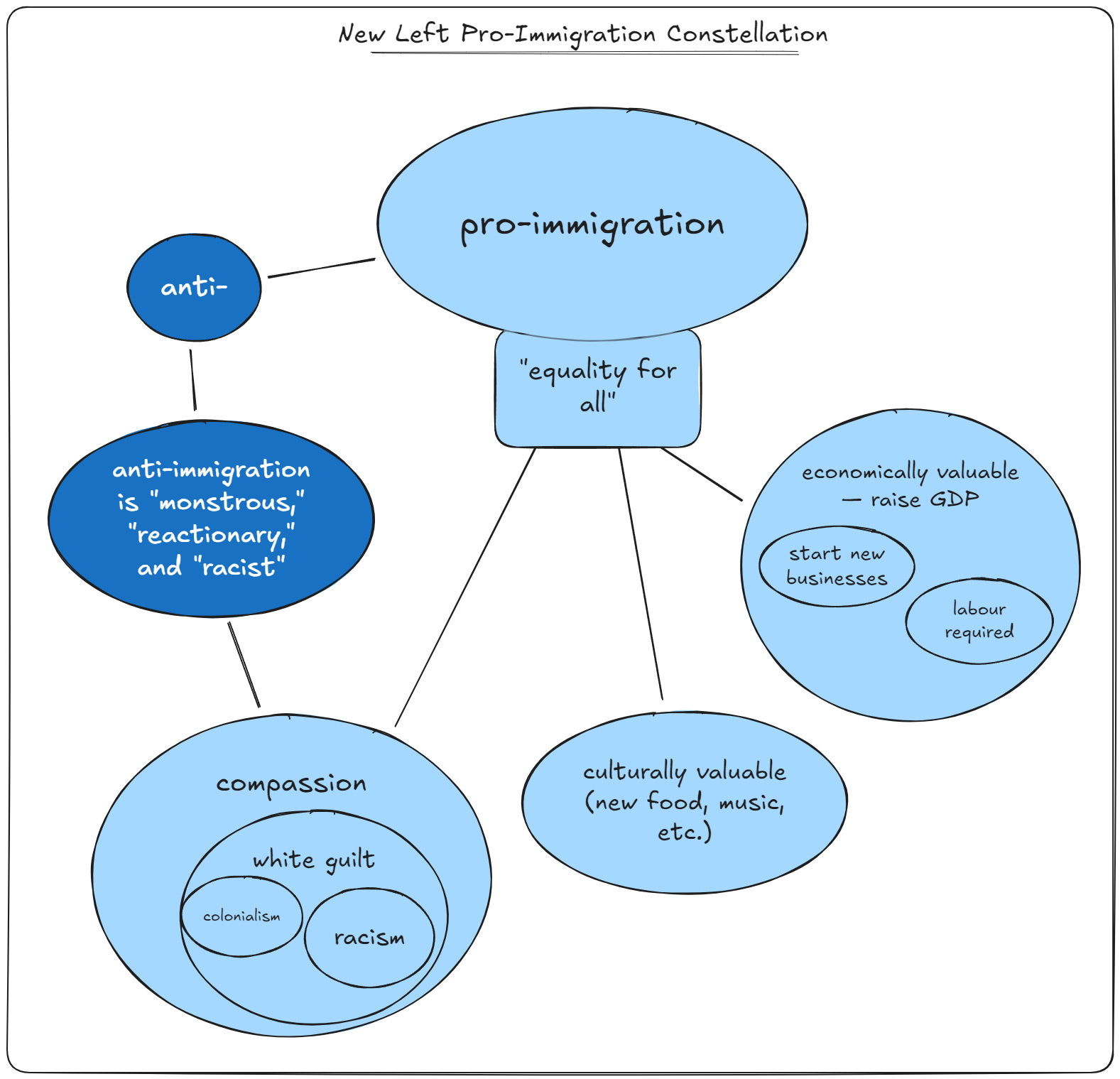
Compassion for all The bedrock of this perspective is compassion (and guilt). The 21st-century left is university educated, and in university we study the carnival of horrors that is history — oppression in all its forms, including slavery, racism, colonialism, sexism, yadda, yadda, yadda.
The major chords of the lefty heart are diversity and compassion for victims. Lefties go to great pains to emphasise the value of the culturally liminal, marginal and inferior, and to promote diversity, equity and inclusion of this heterogeneity.
So far, so predictable.Economic arguments for immigration Curiously, however, these social/cultural arguments for immigration are paired with economic arguments: immigrants provide much needed labour for the economy, and they start new businesses which create even more jobs (more on this later).
Anti-Immigration stance This was the constellation of polite society circa 2024 (the success of Trump has thrown all such values into confusion — see, the death of the Woke). It remains the only mainstream counter-narrative to the Populist Right at play today.
It isn’t easy to opt out of this view. As Mattias Tesfaye, Denmark’s education minister and one of the core drivers of Danish immigration policy (himself the son of an immigrant), put it:
“The fear of being accused of racism has often prevented [politicians] from taking an objective stance on immigration policy.”
According to this constellation, my concerns about immigration numbers in Ireland put me firmly in the “far right” box with the labels “monstrous”, “reactionary” and “racist” slapped on the side.
Not good.
Which is confusing, because I find the Populist Right’s constellation…off-putting. I find a lot of the ideological baggage that comes with that constellation to be “monstrous”, “reactionary” and “racist”.
A tale of two lefts
For many months, this left me politically homeless on this issue. I couldn’t buy into the lefty constellation, and I sure as hell couldn’t buy into the right-wing one. So I was left with a floating belief — disconnected from the confident volition that comes with a consistent constellation.
It was in this dissonant epistemic state that I read David Leonhardt’s article In an Age of Right-Wing Populism, Why Are Denmark’s Liberals Winning? in The New York Times and promptly fell off my horse (so to speak).

.jpg)
Leonhardt’s article charted the movement of the Danish Social Democratic party from a typical pro-immigration stance pre-2015 to their pivot to an anti-immigration lefty party by 2018 and their rise to power in 2019, which continues today.
Of course, in a world where the two constellations above rule the roost on immigration, the Danes have been called “monstrous”, “racist” and “reactionary” for their immigration stance (The Guardian, as ever, being the first to pile on). And they’ve been accused of cynical, pragmatic pandering to voters3.
But that is not the story the Social Democratic party tells. Despite what critics argue, this isn’t a left-wing chassis over a right-wing engine (or would it be vice versa 🤔). The narrative of the Danes invokes a different constellation. This was once the ruling constellation of the left, but in recent decades, it has become an endangered species. Let’s take a look:
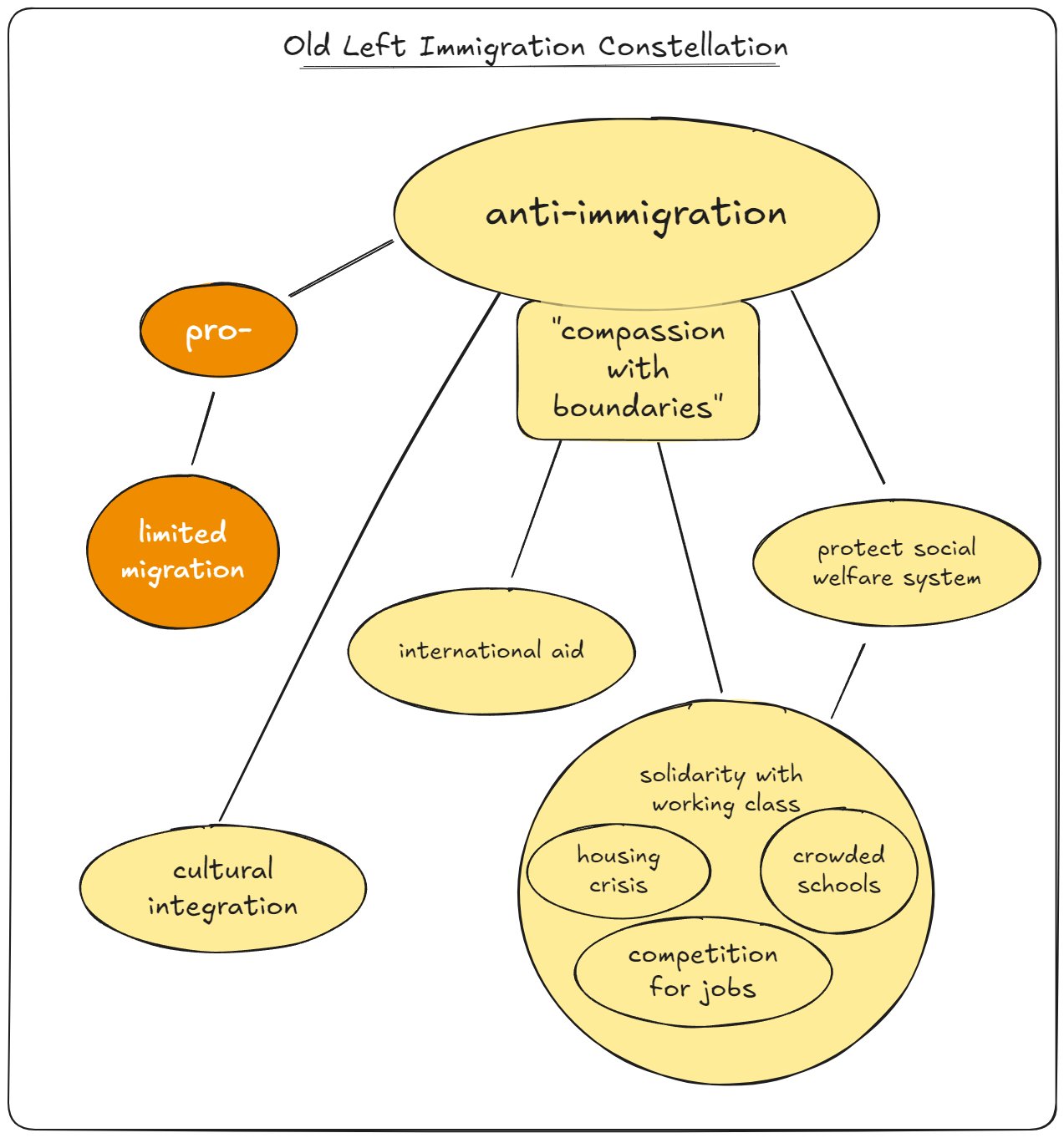
The narrative of the Danes is as follows:
Our solidarity is with the working class. Denmark is a social welfare country and we want it to remain this way. As such, we need to put limits on the numbers of people we can take into the country. We are not turning our back on the worse off but will commit to more international aid to help other countries to rise.
Our duty is to the working class of Denmark, it is they who suffer worst from high immigration since it is their wages and jobs that suffer, their housing costs that rise and their schools that face overcrowding while the white collar class are insulated from the worst effects.
We want a safe and prosperous society for all so integration of all into Danish society is a cornerstone of our immigration policy.
This is a very different story from that of the Populist Right. There is no hate here, no xenophobia.
It is also a breed apart from the mainstream pro-immigration story. The Danish Social Democratic stance makes this narrative seem naively utopian. The thought occurred to me that Denmark has learned the lesson so many gentle hearts have had to learn in their personal relationships over the years: boundaries matter; no boundaries does not equal more love. Boundaries are a painful thing when you are high in agreeableness, and you just want to help a person out, but there’s a reason it’s commonly found in the sadder half of an abusive relationship.
The Danish Social Democratic narrative is one of compassion with boundaries.
As I mentioned earlier, this is not a new narrative. It’s a story keeping with the values of the left — just not the student activist left that has gained hegemony of leftist politics since 1968.
From Old to New
Way back in the 1960s, when big business was calling for increased immigration (which for them meant cheaper labour), the Social Democratic Party at the time pushed back.
“There is only one reason we have foreign workers in Denmark, namely that it pays off financially for businesses,”
Going back further to 1924, American labour and civil rights leader A. Philip Randolph wrote:
”The excessive immigration is against the interests of the masses of all races and nationalities in the country.”
At the same time as the Danish Social Democratic party were pushing back against immigration in the 1960s, a poll found that only 36% of Danish people were in favour of higher immigration. Notably, most white-collar professionals supported the idea while a majority of workers opposed — perhaps pointing to the class lines along which this constellation moves.
1968 was the turning point for this. That was the year the left moved from being a class-oriented movement centred on the working class and unions to being a movement of student activists. The latter breed of leftism (commonly called the “New Left”4 in contrast to the working class centre “Old Left”) put more emphasis on culture — sex, gender and race — than on class.
Seen through this lens, Denmark’s policy is a return to the values of the Old Left. As Fredericksen put it to working-class voters:
“you didn’t leave us; we left you”
Sanderslanche
The Danish Social Democrat policy change has been portrayed as monstrous by the New Left. They are not alone. Their cousin in America has suffered through a similar controversy.
The godfather of the Democratic Socialists in America, Bernie Sanders, was raked over the coals for years for his Old Left anti-immigration values back in 2016. He continued to be anti-immigration until 2020 (when he made an uncharacteristic about-face on the issue). Here he is in a 2019 interview with Ezra Klein on Vox:
Klein: Something you said about being a democratic socialist is a more international view. But I think if you take global poverty that seriously, it leads you to conclusions that in the US are considered out of political bounds. Things like sharply raising the level of immigration we permit, even up to the up to a level of open borders about sharply…
Sanders: Open borders? That’s a Koch Brothers’ proposal.
Klein: Really?
Sanders: Of course. That’s a right wing proposal which says essentially there is no United States
Klein: But it would make a lot of the global poor richer though wouldn’t it?
Sanders: And it would make everybody in America poorer
Bernie is pointing to the old battlelines on this issue. In the days of the Old Left, pro-labour meant anti-immigration; pro-industry meant pro-immigration. This was the message of the Democrats until the Great Awokening.
Since then, however, the Democrats have combined the cultural messaging of the New Left with the economic arguments of the Old Right (curious bedfellows indeed). Which works for a Democratic party appealing more and more to a professional suburban class than the working class.
The reason why Bernie Sanders had mass appeal in 2016 was because he was an Old Lefty: he could still appeal to the working class who have been abandoned by the Democrats, while his integrity and values (aside from immigration) endeared him to the New Left.
But the moment passed, Sanders changed his view, and now the Democrats are running around with their hair on fire, shouting “economic populism! ECONOMIC POPULISM!”
Denouement
The immigration issue proves to be a faultline along which the four major ideologies of modernity rub against each other in unexpected ways. We see the New Left and the Old Right have been married off with their goals in alignment. Meanwhile, the Old Left and the Nouveau Right (the Populist Right) share the opposing stance (though there are no signs of a strategic alliance as between the New Left and Old Right5).
Like the Populist Right, the emphasis of the Danish Social Democratic party is on class. But the latter’s story isn’t one of radical suspicion of the “elite” class but of solidarity with the working class (a subtle but important difference).
It is this combination of compassion, boundaries and solidarity that provoked my road to Damascus moment. Where the Populist Right constellation — with its ethnonationalism and xenophobia — made me wince, this is a constellation I can throw my lot in with. There is no hate in this constellation, there is no reactionary idealisation of the before times. There’s just common sense. I feel like I can talk about immigration without worrying that I’m lending support to beliefs that make me queasy.
It provided a narrative within which the anti-immigration belief cohered with my beliefs. The fact that I felt a need for such a thing in the first place and couldn’t just hold a belief unmoored of such narrative is itself a captivating insight. What is that? The desire to be socially coherent? The desire to be holistic? There is much more meat on this bone, and I’m sure I’ll be picking at it for months to come.
A closing thought
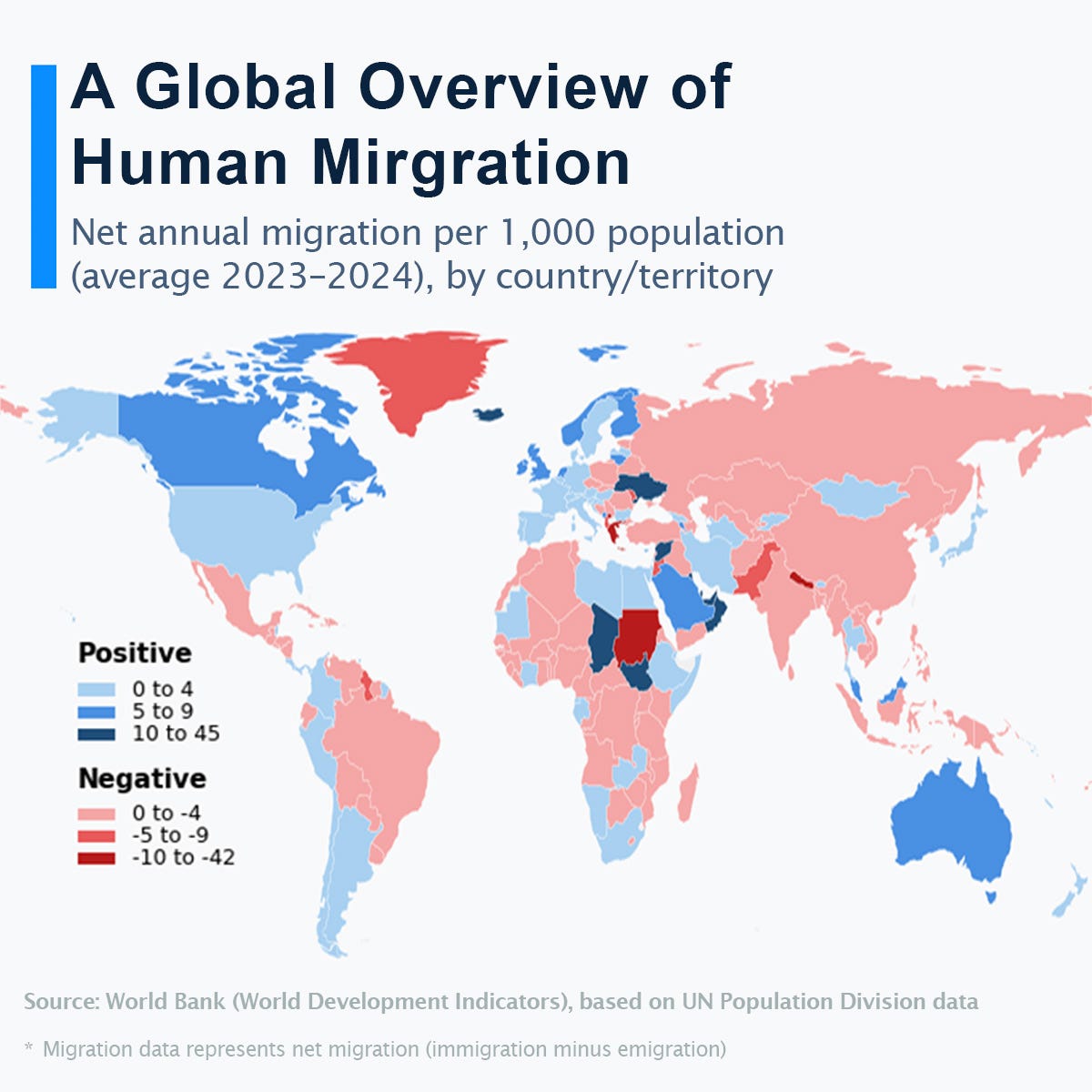
One more thought: in the article, Leonhardt says that
“The world is living through a period of mass migration that has no precedent.”
Counterintuitively, this is because the world is less poor than it has ever been. It takes some means to emigrate. People in developing countries are that bit better off, and so they have the resources to make the journey. Access to social media has also fed this since the usual mimetic and memetic dynamics of seeing others do it, seeing how they do it, and wanting to do it yourself drive such movements at scale.
In this age of mass migration, how much of the push towards the right has been about immigration? How many people have found themselves stuck between a rock and a hard place? Their lived experiences colliding with immigration and finding only two options: a New Left narrative which punishes dissension with labels like “monstrous” and “racist”, or a Populist Right that carries a whole lot of cringy ideological baggage.
Were we to pluck the anti-immigration feather from the Populist Right’s constellation and encase it in a more centrist or Old Leftist narrative, would Brexit have happened? Would Trump have been elected in 2016 or 2020? What has the pragmatic cost of this ill-fated belief been to the causes of centrism and leftism?
students of Girard will note the danger of this emphasis coupled with the righteous warning that “if you don’t deal with the moderates, you’ll deal with the extremists”.
Of course this tweet got mixed up with some hoax that the Irish government issued a “come here” message to the world, and now it is axiomatic in this subculture that the government wants all the immigrants here.
an accusation which invites interesting questions about the nature of democracy
Or the Brahmin Left for the Thomas Piketty fans out there
Exhibit A: the rallying of the Cheneys and Bushes around the Democrat party in the most recent American election points
There is a lot more than centrism here;
https://youtube.com/@americancommunistparty?si=UvFx39fMJbMl0ZDY
ACP, they are the remnants of the old commie left growing on the cracks of the matrix...
You may be interested on it.
Informative and hopefully widely read. Not only Jung’s shadow but human proclivities especially the highly exaggerated empathy and social creature ideas (which we know is exclusive and numbered at its core) come to mind here. Our natures are used more against us in politics than for us.