

Thanks to the success of The Living Philosophy I have had the pleasure of speaking to many amazing thinkers and had my eyes opened and mind blown again and again. I want to help the important work of these great people reach the world as much as I can. The podcast is one great medium but I got thinking that the written word is another.
So when I was chatting to Adriana some time after our podcast (which was amazing and you can check out here) and she was talking about sharing the chapters of her book on her publication I suggested she write a piece for The Living Philosophy. Our chat was everything I could ever ask from the podcast. It was fascinating, eye-opening and full of knowledge I wished the world could have. Her grounded feminine sense of meaning speaks to my heart where meaning has become less of a cosmic affair than a communal one. In an age where AI casts a long dystopian shadow sucking us deeper and deeper into the maw of the machine, Adriana’s work is a welcome antidote. It is a reminder of the solid ground it’s too easy to forget (and essential we do not). I could go on all day about it but that’s quite enough from me by way of intro!
Enjoy,
James
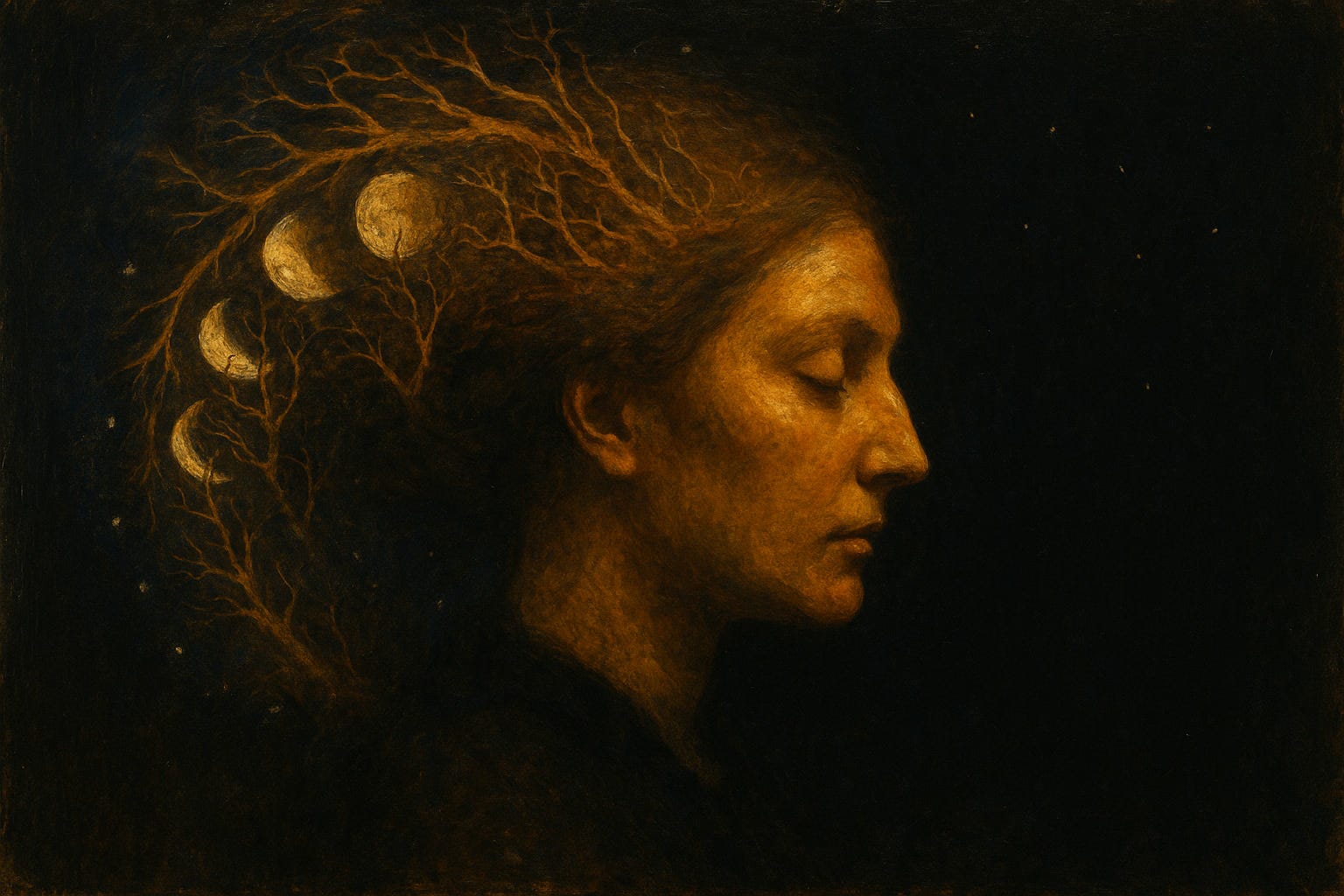
It was Nietzsche who gave the first diagnosis of Nihilism: the death of God.
Or, more precisely, meaning-less-ness.
But what if there is a whole other side to this story?
The problem of the neutral human
One of modernity’s most enduring assumptions is that human subjectivity is essentially neutral.
Of course, we acknowledge differences between people, but beneath those differences we tend to imagine that it shouldn’t really matter what body a thought comes out of: male, female, French or Cherokee, what’s the difference?
“Why should it matter?” the modern mind thinks.
It’s the logic that lures us into believing that philosophical, psychological, medical, educational, developmental and spiritual frameworks created almost entirely by male thinkers should apply equally to everyone.
But this flawed assumption is where the very foundations of our thinking begin to go awry.
Subjectivity, as we know it, refers precisely to the fact that our feelings, sensations, histories, bodies and perspectives shape how reality appears to us.
There is no view from nowhere.
And yet we have behaved for centuries as though there were.
This isn’t a new thought. Here’s Nietzsche (again) in the third essay of the Genealogy of Morals:
“My dear philosophers, let us be on guard against the dangerous old conceptual fiction that posited a “pure, will-less, painless, timeless knowing subject;” let us guard against the snares of such contradictory concepts as “pure reason,” “absolute spirituality,” “knowledge in itself”: these always demand that we should think of an eye that is completely unthinkable, an eye turned in no particular direction, in which the active and interpreting forces, through which alone seeing becomes seeing something, are supposed to be lacking; these always demand of the eye an absurdity and a nonsense. There is only a perspective seeing, only a perspective “knowing;” and the more affects we allow to speak about one thing, the more eyes, different eyes, we can use to observe one thing, the more complete will our “concept” of this thing, our “objectivity,” be. But to eliminate the will altogether, to suspend each and every affect, supposing we were capable of this—what would that mean but to castrate the intellect?”
— Nietzsche, Genealogy of Morals, Essay 3
Which brings us back to “the meaning crisis”.
What if the “death of God” meant something different for male and female subjectivities? What if women didn’t experience a “meaning crisis” or a “dead God” until we were told we did?
What I am saying is that this is the type of confusion that can happen when a partial metaphysics becomes the metaphysics. When one way of seeing becomes so normal that we stop seeing it as a way of seeing.
I am not speaking here to the truth of everyone’s unique perspective. This is obviously true. But when we forget that this uniqueness is experienced from bodies that carry a particular pattern, the conversation about uniqueness can become more confusing than enlightening.
For the rest of this piece to make sense, we’ll need to create a small agreement between us:
We will not pretend that the thoughts I share here emerged independently of the body writing them. We will be hyper-conscious that the vantage point I am putting forth could only have become visible in this way because I am a woman.
More specifically, because I am a woman who cycled for decades and has now crossed menopause. That transition also matters.
It matters because for more than thirty-five years, my experience of myself and the world was shaped by an oscillating hormonal landscape that “in-formed” my subjectivity in a very specific way. I now inhabit another landscape entirely.
Neither has given me access to “the Truth”, but both have given me access to a vantage point that males will never inhabit.
If you’re a woman who has never thought about your mind in these terms, read like an explorer. Notice what happens in your body as you read further.
I open my upcoming book with the following thought:
What culture cannot name, it struggles to perceive. And what it cannot perceive, it cannot protect.
I hope you are beginning to see how veiled the problem I have been working with is…
But that’s just the beginning. What we are going to dig into with the rest of this piece is the insight at the core of my work:
Not all extinctions announce themselves.
Some happen quietly, below the threshold of awareness.
A thinning of silence. A dimming of stars.
The disappearance of insects, of languages, of ways of knowing.
But perhaps most dangerous is the loss of the very capacities that would allow us to notice what we’ve been losing, and what has already been lost.
What I am pointing towards is something I have come to think of as the quiet extinction of the female mind.
I even gave it a name, so we can see it more clearly.
Gynostalgia
The lived female experience in modernity
(gyno = woman/female + stalgia/algia = ache)Grief for the loss or estrangement of the female way of being whilst living as a woman.
(Often experienced as “crazy making.”)
Gynomnesia
The cultural condition shaping women
(gyno + mnēsis = memory)The cultural forgetting of the female mind.
(A collective form of crazy)
Extinction here isn’t a question of the quantity of women or their brain cells. It’s about quality.
As we know, women have entered universities, laboratories and governments in unprecedented numbers and become extraordinarily competent in the modern world. But that success has come at a cost.
The fundamental assumptions of that world were largely established without taking the female body-mind into account.
We entered the structures, learned the language and became brilliant at it, but somewhere along the way, we mistook adaptation for liberation.
Cycle Dysphoria - the Birth of the Meaning Crisis (for Women)
We can all recognise that modernity rewards a particular kind of mind: the mind that separates things into parts, studies them independently through analysis, measurement and abstraction.
This is not the default of the female mind.
If anything, it may be closer to its opposite.
The language we have gotten used to is one of forward movement.
We speak of progress as though it necessarily means continuous “improvement”, accumulation and movement forward.
We see economic growth as moving forward; we talk of careers moving forward; and we see technology moving very, very quickly. Forward.
We have equated forward and up with good. We have also equated more with good.
But what if meaning resided somewhere else?
What if slowing down, descending, gestating and dying had something to teach us about meaning?
Those attributes are more difficult for modernity to metabolise, largely because they require capacities and sensibilities that have been continuously overlooked and bypassed by what modernity considers “important” or valuable. Through this process of continuous overriding, meaning started being seen as a concept instead of something felt. Instead of something living and embodied in experience, meaning became another abstraction, leading us away from life right when we thought we were facing it.
I call this broader cultural condition Cycle Dysphoria, and it speaks to our individual and collective discomfort with the descending movement of cycles: the contraction, the release, the dissolution and much of what makes regeneration possible.
Once you look around, you’ll see it everywhere.
We extract from the soil without giving it enough time to rest; we extend “productivity” into the night; struggle enormously with ageing; medicalise our transitions; resist death; and turn even birth into a timetable.
Modernity is extraordinarily good at the upward curve but has very little idea what to do on the way down.
Eradicating “the way down” meant relating to what is really happening as if it were an abstraction.
This is, how can I put it gently, delusional.
And this is where the female body becomes philosophically interesting.
This is where female subjectivity can “re-mind” us of where meaning resides.
The female body refuses the straight line.
For much of her adult life, a cycling woman’s body makes linearity rather difficult to believe in. Her physiology oscillates: hormones rise and fall, energy changes, attention shifts, sexuality and perception move with them. The body prepares for possibility, then releases it only to prepare again. Eventually, through perimenopause and menopause, this entire rhythm begins to change and dissolve into something new.
For the female body-mind, impermanence is not something to be cognitively understood. It is something it performs, again and again and again. And we haven’t even spoken about gestating and birthing a baby.
Can you begin to imagine what happens to a woman’s mind during such phases?
The female body carries an embodied confrontation with something modernity has become remarkably skilled at avoiding. One of the biggest gifts of the female vantage point has become obscured even to the woman herself. A woman who moves through monthly cycles has somehow begun to believe in theories that weren’t created for her and that have rarely spoken about her experience. And yet women know, in their bodies, that the descent is not a failure of the ascent. It belongs to the same movement.
The female experience is embedded in meaning. Beauty has meaning. Awe has meaning. Gestating has meaning. Birthing has meaning and so has death.
None of it is conceptual; all of it “meaning-full”.
What if a big part of women’s role is to help us re-member our “meaning-full” ways?
Let this thought simmer in you for a bit…
Nietzsche’s proclamation of the death of God described an enormous rupture in Western consciousness, but I wonder what that rupture might have looked like from “the other side”.
Let’s do an imaginal exercise.
What if the death of God, as Nietzsche saw and articulated it, was simply the problem as perceived through a male subjectivity of his time? And what if women had been sufficiently present in philosophy, then, not as women learning to think within a male philosophical tradition, but bringing the female body-mind fully into the conversation, to understand his provocation and offer a counter-piece?
Perhaps they might have seen the “death of God” as a symptom of what happens when philosophy itself begins to leave the body, when we begin to imagine ourselves as separate from the living world that holds us.
The mechanistic worldview is the kind of dream the male mind can dream when left to its own devices without the input of its counterpart, its “partner in crime”, the female mind.
What I am articulating doesn’t make women morally superior; it simply places us, women, where women should be: in the conversation.
Because bodies teach, and bodies teach differently.
A body organised around oscillation, bleeding, gestation, birth, death, nourishment and eventually the great transition of menopause is repeatedly reminded that it is embedded in processes it cannot control. It relates to life more like a forest than a pruned garden.
From this vantage point, ecocentrism, the understanding that humans exist within, rather than above or outside, a larger living system, is not an intellectual position but something the female body knows from the inside.
It was with the death of our honouring of the female mind, not the death of God, that much of what she cares for has become invisible to us.
Meaning lives in the present moment, and somewhere in her body, she knows it.
When we lost the capacity to harness or even attune to what indigenous tribes have classified as the domain of “women’s business”, all that women tend to have shrivelled, leaving us all, modern folks, intellectually clever and malnourished in the soul.
The female body-mind teaches us to see ourselves as embedded rather than separate, to recognise our relationship with cyclical time, our tolerance for mystery, our ability to descend without immediately trying to climb back up, and to trust in ways of knowing that emerge through participation and relationship.
The tragedy is that modern women have largely learned to interpret these capacities through the metaphysics of the straight line.
When a cyclical being looks at herself through a linear mirror, she inevitably appears defective.
So, not only could she not offer a counterpoint to the crisis in meaning, but she also began enacting the crisis herself.
She began seeing herself and her cyclical ways as faulty.
I don’t know what’s wrong with me today. I can’t think. I’m too emotional. I’m unfocused, she says, when her mind is operating in ways that make it harder for her to fit into modernity’s constraints.
I’m not myself, she says.
Every time I hear this, I wonder: who is the self she is failing to be?
Usually, it is the version of herself that can concentrate, produce, socialise, care, work and perform with relative consistency. In other words, the version most compatible with modernity.
The other woman, the withdrawing woman, the “foggy” woman, the woman who suddenly cannot tolerate what she tolerated last week, the bleeding woman, the postpartum woman, the menopausal woman, is experienced as a disruption of the “real” one.
This is how something can become extinct without ever technically disappearing. This is how a capacity can remain biologically present while becoming culturally unintelligible.
Eventually, even the person carrying it stops recognising it.
This, I think, is one of the most dangerous forms of extinction: when we lose something without ever knowing that we have lost it.
The same worldview that struggles to make sense of a woman’s changing body struggles to understand a forest that needs to remain “unproductive” for a while.
The same culture that sees menstruation as lost productivity sees fallow land as wasted land.
The same metaphysics that breaks the body into parts breaks ecosystems into resources.
The same inability to tolerate the descending phase of our own lives makes endless economic growth appear not only possible, but desirable.
As I hope has become clear, women’s minds are woven in experience. Even though modernity has somehow made it possible, it is harder for women to live entirely in abstraction. Our cycling, gestating, birthing and feeding bodies are relational, ecological and “meaning-full”, not as concepts, but as lived experience.
In seeing male and female minds as essentially the same, we may have lost what only becomes possible in a dance.
I’ll leave you with this.
Could the meaning crisis be something other than what we think it is?
Here is an invitation.
If you are a woman, let your body re-member. If you are a man, gift a woman you love with this re-membering. Observe the ways she moves through the world as if it were alive (and, of course, it is), full of meaning.
Have you ever seen how she weaves, smells a flower, nurses her baby, puts lipstick on? Dances or creates?
Could meaning really ever be lost if you have eyes to see?
Ask her to teach you how to see, how to re-member (put yourself back together)
But you can’t be in your head. You can’t be in a rush. You can’t think you already know.
If you do that, who knows? You may experience a God who has never died.
Adriana is setting out to break the spell modernity has put upon us and that can only be done communally so if you feel like waking up from the stupor hop over to her publication “The C-Lab”. Over the next 9 months she’ll be releasing chapters of her book The Matriarch and the Machine with an invitation for us all to come in and metabolise it together.
