

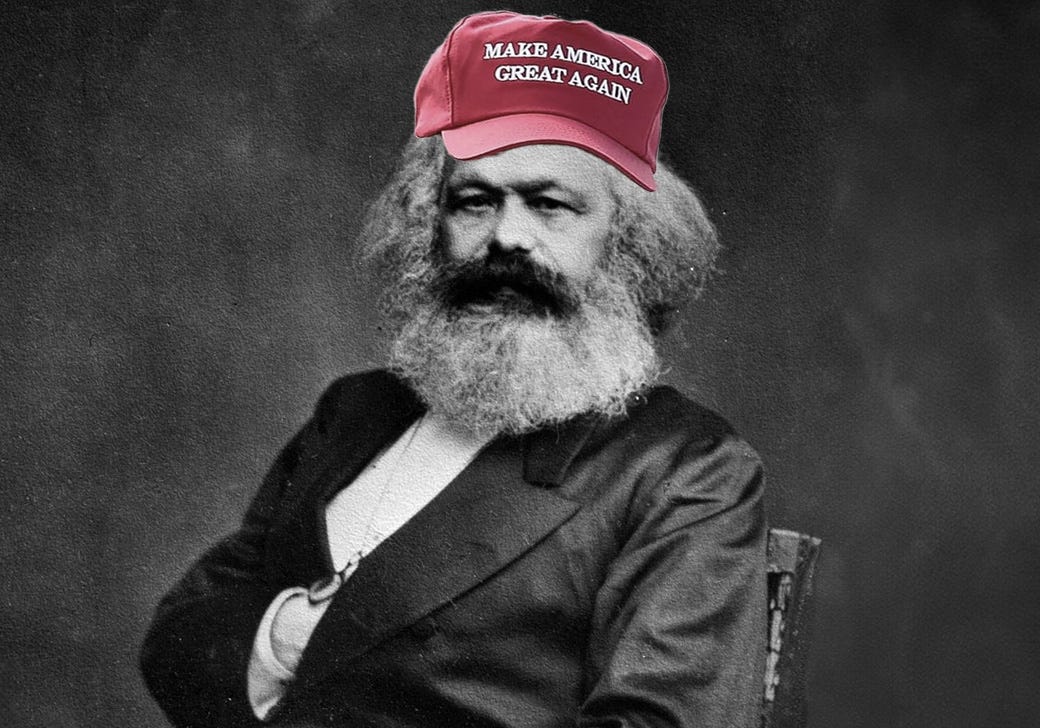
Sensible, mature, moderate political thinkers can’t comprehend the radical urge.
Their common sense reminds us that when GDP goes up, the boat rises for everyone. The great Neoliberal revolution of the 1980s, which ran out of steam somewhere around 2016, saved the economy from the doldrums of the 1970s and unlocked brave worlds of lucre.
The seeds of our Populist era were planted in those days.
You see, there was some inequality in this unleashing. The great social support behemoth of Neoliberalism's predecessor—the Keynesian economics which had ruled the world since the New Deal of the 1930s—was dismantled by the Gilgameshes of new economic model. The public was privatised, the local was globalised and regulations and taxes cast into the pits from whence they came. These tethers holding down the global economy severed, Mammon buoyed and oh boy did he buoy.
But, as previously stated, this Neoliberal touch of Midas was uneven (which is why the hollowed out mining communities of northern England will always reserve a special place in Hell for Maggie Thatcher).
Sure, as the economy grew, the boat rose for everyone. But not equally. Not even close. This inequality is drawn along geographic and class lines. Big cities were always going to be fine. But places like Northumberland and Detroit, which saw their great working class forges quenched, were another story.
Neoliberalism’s dismantling of regulation and taxes catalysed the takeover of corporate society. Bye bye, Ma and Pa; hello Whole Foods. Your food got cheaper, but your jobs and your community paid the balance.
And what’s more, those fat cats got fatter. Let’s look at who got richer and by how much.

But the sensible refrain remains: the boat rose for everyone.
People think Karl Marx was a bit cuckoo these days because of the Gulags and the killing fields of Cambodia. But there’s something Jordan Peterson and the other Red Scare revivalists don’t appreciate about the appeal of Marx. It’s a very simple, universal, human thing.
We hate exploiters.
The sensible moderate looks at the above diagram and sees a story of growth. The boat rises for everyone by allowing the biggest growers to grow more. There is a trickle-down effect where this wealth pours down from on high like a champagne tower.
Marx whispers a different story. It’s a story about justice.
Marx's story can be boiled down to one word: value. And the value of that thing with the price tag comes from three things: the equipment to make it, the labour to produce it, and the capital to fund that production. The trouble is, despite the fact that the labourers do the making, they see only a fraction of the surplus. The capitalist takes the lion's share. "Why do you get so much?" says Marx "that's not very fair". And a century of revolutionaries agreed.
Both the Marxian story and the sensible moderate story are correct. But the moderate story is about absolutes, and the Marxian story is about relativity. “You are better off than you were" the common sensicals says "and everything is cheaper as well (except for those things run by inefficient governments of course like healthcare, education and infrastructure)”.
Meanwhile the Marxian says “yeah but look at them”. Were Herr Marx here today he might point out that since 1978, CEO compensation has grown 1322%, but typical worker compensation has risen 18%. Or, put another way, in 1978, CEOs made around 30x more than their workers but by the year 2000 they were earning 372x the worker on the floor. To Marx and his radical cousins, whether they are social justice warriors or far-right Populists, the relative matters more than the absolute.
The psychology behind this will come as no surprise to anyone familiar with Game Theory. In the Prisoner’s Dilemma, people will happily leave with nothing in order to punish a bad actor. The level of abstraction of sensible society befuddles this enough that we get around this petty element of human nature (for the most part).
But with the age of Populism, this infernal chicken has come home to roost. Of course, the Left would traditionally have been the party of economic inequality and class gripes, but their trajectory in this period led them more towards cultural inequalities (race, sex, gender)—that is, the paradigm shift from the Old Left to the New Left (as some commentators are fond of calling it "The Great Awokening".
And so it was the far-right that ended up channelling this Marxian discontent (which anyway is more suitable as a vent for rabid id energies). Sensible moderates are baffled at how Populist voters can shoot themselves in the foot by supporting a campaign that hurts them in their pocket. But the promise of Populism is anti-establishmentism; it is hatred for the elites. Populism has risen on the uneven geographic and class distribution of the Neoliberal lucre.
Another fact Marx wouldn’t have overlooked: the Brookings Institution found that the fewer than 500 US counties that went for Hillary Clinton in 2016 represent “a massive 64 per cent of America’s economic activity as measured by total output in 2015.” Meanwhile, Donald Trump won more than 2,600 counties. Together, they represent just 36 per cent of the nation’s economic output." Here’s what that looks like on a map
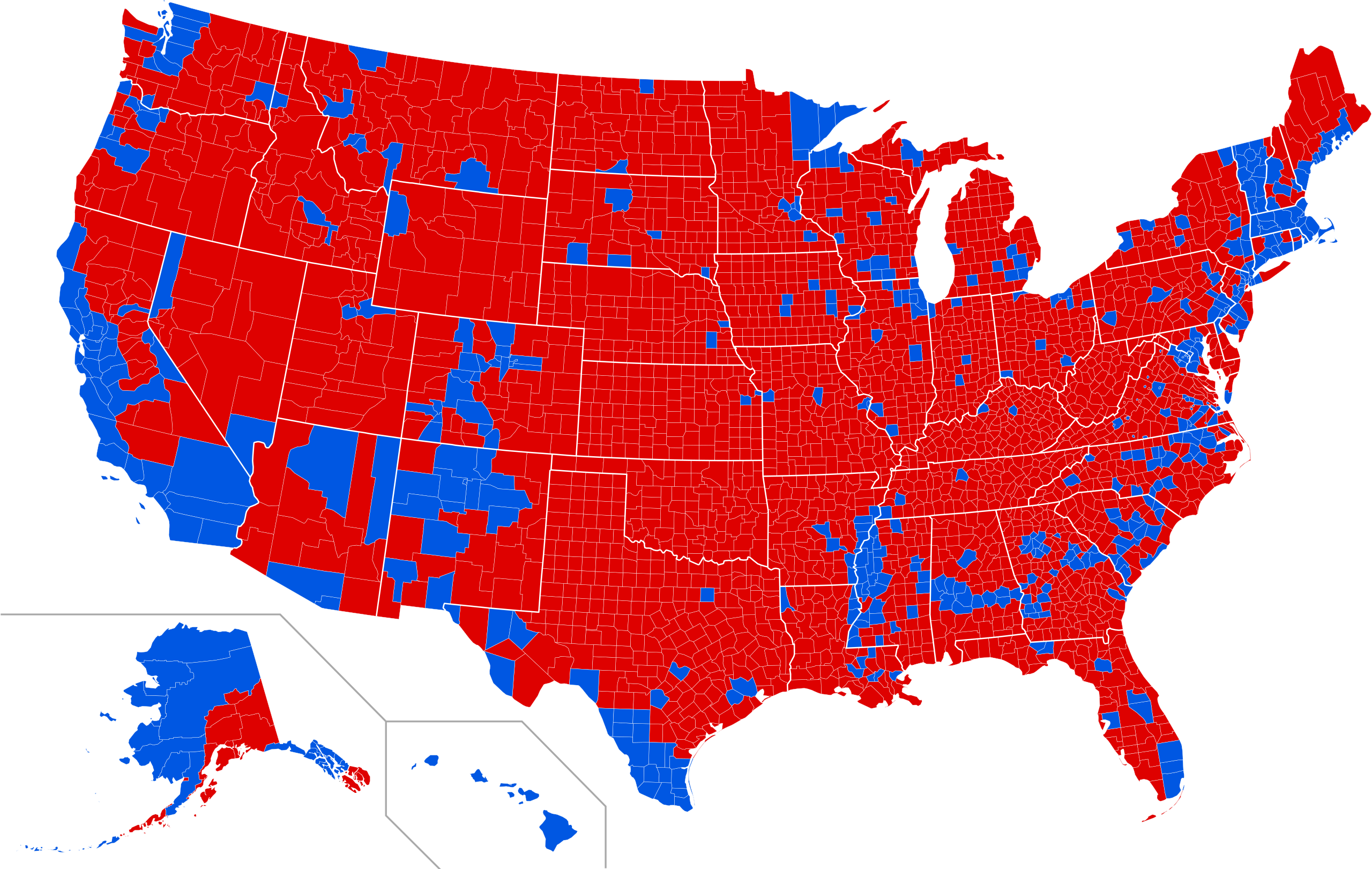
An ocean of discontent. A map of geographic and class inequality. It’s the story of the left behind “somewheres” rising up against the elite "anywheres”.
Our age of radicalism is an age of rebellion against the privilege of the absolute. It’s the irrationality of the Prisoner’s Dilemma played out on the level of global politics1. We live in the age of MAGA Marx.
Even Trump’s rhetoric around the tarriffs fits in here: ”we import more than ye. No fair.”
People aren’t just angry about what they lack. They’re angry about what others have. Populist rage isn’t driven by poverty alone, but by the sense of being left behind while others soar.
The tragedy? That class resentment got redirected into culture wars, instead of solidarity.
I also feel liberal cultural dominance was a heavy factor in the rise of MAGA.
https://squarecircle.substack.com/p/maga-as-the-liberal-shadow