


This is the third instalment of The Philosopher’s Toolkit. For an introduction to the series, see here. It was inspired by two things: Deleuze’s definition of philosophy as “forming, inventing and fabricating concepts” and the old saying that “if all you have is a hammer, every problem begins to look like a nail”. The Philosopher’s Toolkit aims to give you more tools for interacting with the world.
This week, I’m delighted to present a guest post by Stoic writer (and fellow Irishman) Enda Harte, who writes beautiful reflections on Stoicism over on his publication The Irish Stoic. If you like what you read and want more Stoicism in your life, you can check his Substack out here or follow the link below.
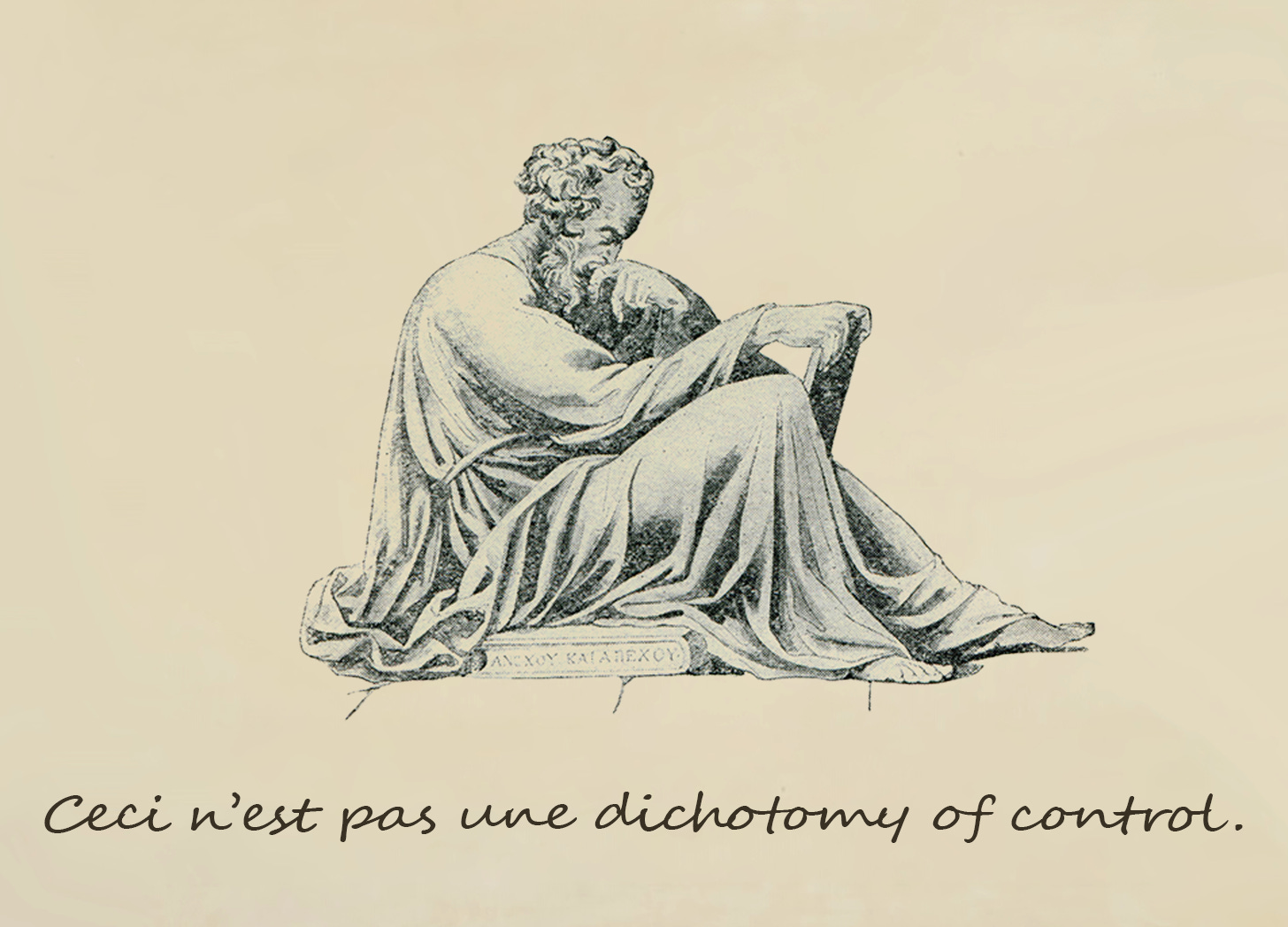
Category: Personal Development
Thinker of Origin: Epictetus
School of Origin: Stoicism
Where it’s popular: Stoicism, Personal Development (see Stephen Covey’s Circles of Influence and Concern), Cognitive Therapies like CBT.
Useful for:
Resilience building, decision-making, and emotional control
“…Remember, then, that if you suppose that things which are slavish by nature are also free, and that what belongs to others is your own, then you will be hindered. You will lament, you will be disturbed, and you will find fault both with gods and men. But if you suppose that only to be your own which is your own, and what belongs to others such as it really is, then no one will ever compel you or restrain you. Further, you will find fault with no one or accuse no one. You will do nothing against your will. No one will hurt you, you will have no enemies, and you will not be harmed.
— Epictetus, The Enchiridion, 1
We live in a world of expectations. Whether it's how people should behave, how plans ought to unfold, or how success is meant to look, much of our inner turmoil comes from wanting life to follow our own script.
Epictetus, a former slave turned Stoic teacher who lived nearly 2,000 years ago, offers an antidote to this kind of suffering; sort the world into what you can control and what you cannot. Then, commit yourself fully to what is yours and let the rest go.
This idea - known as the dichotomy of control sits at the top of the pile in modern Stoic practice. For me, it offers not just theory, but a guidance system for navigating situations in daily life, with equanimity at its core.
So What Is Within Your Power?
The Enchiridion of Epictetus (a small handbook for living) opens with a blunt truth: some things are up to us, and some things are not. What’s up to us? Our opinions, impulses, desires, aversions – in short, our choices and how we respond to life. What’s not? Our body, wealth, reputation, and most events in the world around us.
This distinction isn’t abstract. It’s practical. For instance if you’re anxious before a job interview, remind yourself; your preparation, attitude, and how you carry yourself are yours. The interviewer’s mood, company policies, and what other candidates bring to the table are not. Focus on your part, and learn to accept the rest.
Some Stoics believed that mixing these two realms i.e., trying to control what isn’t ours and neglecting what is lies the root of frustration. Epictetus puts it plainly; if you treat only what is truly yours as yours, then “no one will ever compel you or restrain you... you will not blame, and you will not be harmed.” Your peace of mind doesn’t come from external safety but from internal clarity.
A Toolkit for Everyday Life
Practising the dichotomy of control boils down to two key steps: (1) clearly identify what is within your power, and (2) accept the rest. Here are some practical exercises and examples for everyday life:
1. Ask Yourself, Is This Really Up to Me?
Anytime you sense tension, take a step back and ask, "Is this within my control?" This is the first trigger point of the exercise. If the answer is yes, how you act, what you say, the effort you give, and holding yourself accountable is what you need to focus on. If not; someone else’s opinion or dredging up past events, then consider letting it pass through.
This one habit, done consistently, in theory sharpens your focus and softens your impulses.
2. Drop What Isn’t Yours
Epictetus’ teaching suggests that if something lies outside your control, be ready to see it as nothing to you. That doesn't mean indifference in a cold way. It means acceptance. If your train is late, getting angry won’t make it arrive faster. You’re not the manager of the rail network (usually). You are in charge of your response, illustrating patience, your choices, and how you use the time is a way to address this swell of bad emotions.
This isn’t about outright passivity either. It’s about the efficiency of what you place effort into.
If you’re on a boat in open waters, worrying about the wind won’t ultimately help you, though it isn't to be completely ignored. But focusing on steering your own sail might be a better use of your time. (The Stoics loved to use sailing and water metaphors).
3. Focus on What You Can Do
In moments of pressure or setback, return to your own involvement. If a project at work doesn’t work out, focus on how you contributed, what you’ve learned, and what you’ll do better next time. The outcome is gone. Your approach and effort level remain, the frustration does not.
The Stoics were generally interested in the right use of appearances. Meaning how we interpret and handle what happens. That’s where we grow. And where true freedom lives.
Anecdote: Cicero’s Archer Metaphor
Cicero — a Roman orator and philosopher — gave us a great metaphor to coincide with this principle. Just as an archer must aim at a target to hit it, so must a person aim at a goal or purpose to achieve it. In regard to this concept it is important to choose a goal that is within one’s control and not heavily dependent on external circumstances.
The archer must be prepared to adjust their aim based on changing circumstances, such as wind or distance, and in the same way, a person must be prepared to adapt their goals or strategies based on changes in their life circumstances.
4. Practice another Stoic Perspective
There are exercises to help this mindset stick. One is premeditatio malorum, aka imagining what could go wrong. Before an important event, take a moment to picture setbacks. Not to be gloomy, but to loosen your grip on outcomes. If things don’t go your way, you’re not surprised. You’ve trained for it. Easier said than done, I know.
Another exercise from the Enchiridion is detachment through generalisation. Epictetus says, if you’re fond of a ceramic cup (any possession), remind yourself it’s just that a cup, and cups break. That way, if it does break, you’re not completely undone. Apply this to anything: your car, your phone, even a relationship. Love it while you have it, but be ready to release it.
Each day, you can practice by keeping a record or simply mentally noting what caused frustration and classifying it. Over time, this trains your mind to focus on efforts not outcomes, building mental resilience.
Real Freedom

At its deepest, the dichotomy of control is about freedom. Not freedom from pain or challenge, but from being a slave to things outside your power.
Epictetus was born a slave. He walked with a limp for life. And yet he taught that no tyrant, no injury, no turn of fate could take away the only thing that truly mattered: your ability to choose your response. As he put it, someone may chain your leg, but your mind remains free. Not even the gods could touch that.
This radical freedom is the Stoic ideal: no one and nothing can force virtue or tranquility from you. From Epictetus and indeed other Stoics we learn; peace is possible, but it’s not passive. It takes discipline. It takes self-examination.
But if you hold fast to what is truly yours — your reasoned choices, your values, and your effort, then nothing in the world can make you act against your better nature.
Expanding This Concept
Some modern Stoic thinkers propose a useful refinement to Epictetus’ model, which I think is important to mention: the trichotomy of control. Rather than just two categories — things we control and things we don’t — this approach includes a third, things we have some influence over. Let’s break it down:
Fully within our control: Our beliefs, judgements, decisions, and actions.
Partially within our control (influence): Relationships, team projects, negotiations, health and wellness.
Completely outside our control: The past, other people’s actions, natural events, chance, and dying.
This middle ground acknowledges the complexity of real life. For example, you can’t control whether a friend forgives you, but you can apologise sincerely and try to rebuild trust. If a loved one falls ill, you can’t change their illness, but you can choose compassion, assist with their care, and focus on acceptance instead of outright panic.
In these situations, a Stoic approach means doing your best within your influence, without clinging to outcomes. You still let go of what isn’t yours to command, but you don’t ignore playing your part. Remember, no shouting at the car in front of you. No begging for the weather to change. Just the steady hand on the tiller, moving forward with what’s yours to steer.
Whether this deviates from the purist point of true Stoicism or not, is up for debate. This updated chain of thought isn’t without its controversy, and has caused heated conversations between academic minds on what pertains to being the correct version of this theory.
Epictetus would be proud!
Final Thoughts
Human nature hasn’t changed all that much since Epictetus’ time. We all still get caught up in outcomes, possessions, status, and worry about things we cannot bend. But you don’t have to live that way.
As modern Stoic enthusiasts and academics note, this echoes cognitive-behavioural therapy - we aren’t troubled by events themselves, but by our beliefs about them.
The dichotomy of control therefore isn’t a retreat from life. It’s a way of standing tall within your life. From experience I have found it to help me face uncertainty with calm, and deal with success without arrogance. It’s a reminder that my job is not to run the universe around me, but to guide myself well within it.
This mindset can be valuable in modern life. But it takes quite a bit of practice. The aim is to replace destructive emotions like anger, envy, and general frustrations with hopefully healthier ones. The Stoics called these Eupatheiai or good feelings. Joy in doing what is right, and to remain calm in the face of adversity.
In Epictetus’s view, this “role” of focusing on your own mind is the highest calling of the rational human. And that, for any person seeking to improve themselves, is more than enough to keep you busy.
Sources:
Epictetus, Discourses (Arrian’s report) and Enchiridion.
Taking Control by Enda Harte, and
https://classics.mit.edu/

Thank you for having me over to write a special guest piece. I hope your readers enjoy, and a have a nice summer ahead!
Great article Thanks