

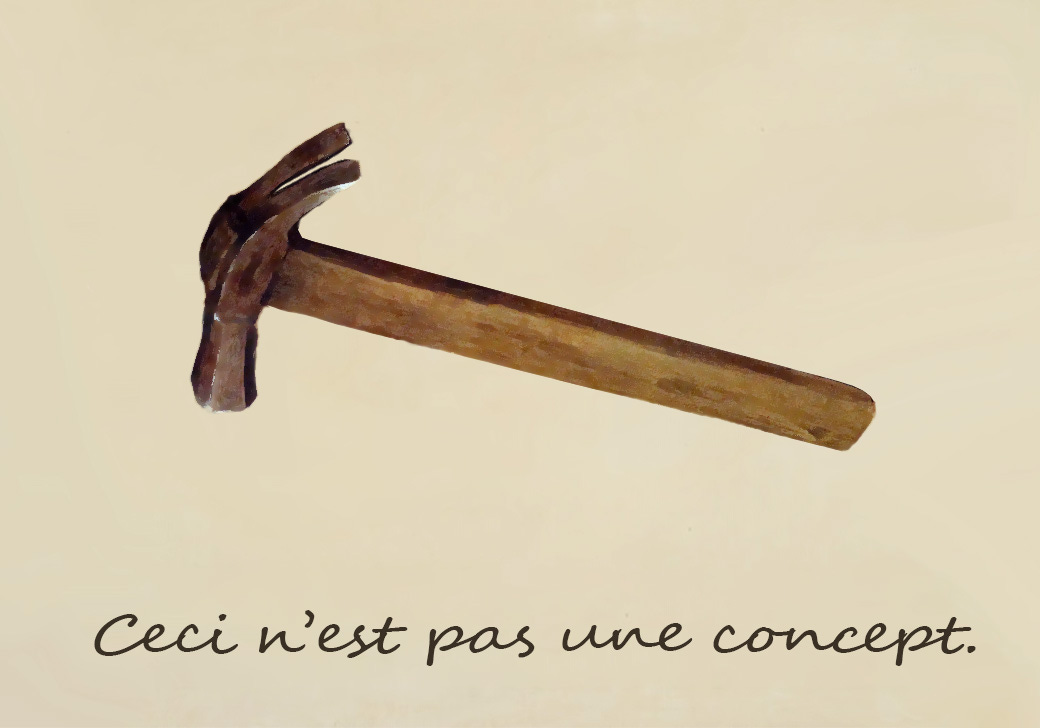
The fecund Postmodernist Gilles Deleuze once said that the work of philosophy is “forming, inventing and fabricating concepts”1. I love it. It’s a definition of philosophy that makes its use and importance obvious.
There’s an old saying that “if all you have is a hammer, every problem begins to look like a nail”. Concepts are tools. This one a hammer, that one a compass; over there is a spokeshave, and by the door there’s a shoehorn. It’s good to have tools; it’s good to have concepts.
Another great line from Deleuze, which I think gives us another angle on this:
“Writing has nothing to do with meaning. It has to do with land surveying and cartography, including the mapping of countries yet to come.”2
In the mythopoetic language of Jordan Peterson, this is the story of Gilgamesh cutting up the conquered corpse of the monster Tiamat — the embodiment of Chaos — and giving Order to the world.
Without concepts, the world is a confused whole. With concepts like silence and rhythm, we can give shape to the world of sound around us; with concepts like brightness and colour, we can bring order to the visual world; and with concepts like kind, cruel, sensitive and moody, we begin to give order to our interpersonal experiences.
In our complexifying world, we need more and new concepts to navigate these strange waters. One of the great joys of philosophy and psychology for me has been the arsenal of concepts it has provided me. I find Jung’s concepts of Shadow and Projection to be useful to me; I find Baudrillard’s concept of the hyperreal to be an apt description of our complex world; I love Wilber’s four quadrants, Marx’s Base and Superstructure, Nietzsche’s death of God and Peterson’s Chaos and Order.
With that in mind, I would like to embark upon a new weekly series: The Philosopher’s Toolbox. Each week, I’d like to add another concept to the toolkit. Some of them you may find no use in and discard, but I hope that some of them will prove useful to you. Perhaps where you once used a hammer, you may now use a screwdriver. We’ll be looking at everything from razors and traps to models and maps as we bring order to this chaotic world.
What is Philosophy? by Gilles Deleuze and Felix Guattari p.2
From A Thousand Plateaus. This is the popularly quoted version. The slightly more opaque version you’ll find in the book: “Writing has nothing to do with signifying. It has to do with surveying, mapping, even realms that are yet to come”
This sounds like a great idea! Looking forward to it.
Let me know if you’re looking for any guest writers. Excited about the new series.