

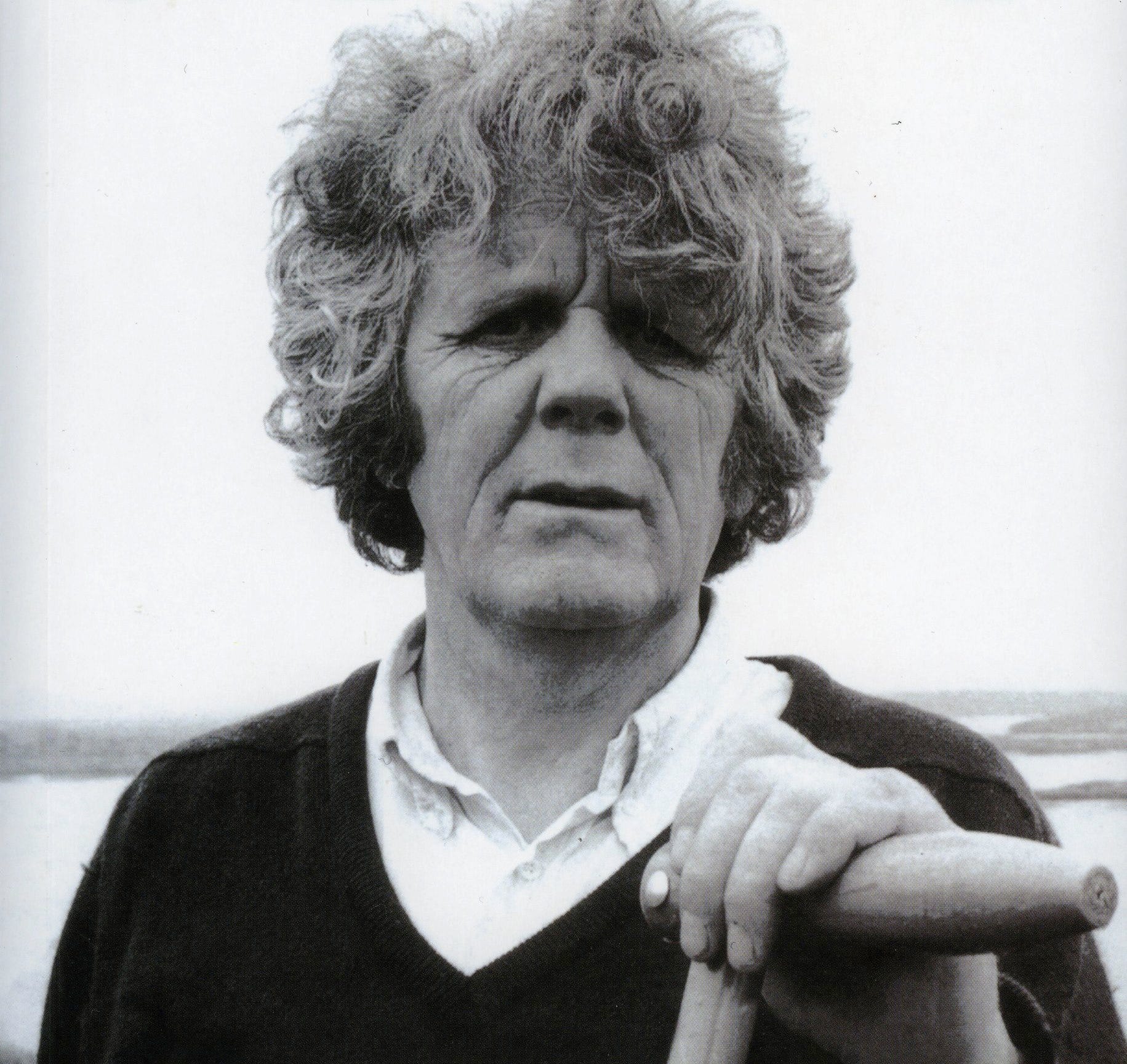
I’ve started reading John Moriarty. May God help me.
John was from a village called Moyvane, just over the border from Limerick into the glorious county Kerry. There was a celebration on for his birthday in Moyvane a couple of years ago; a family friend from Moyvane gave me a ticket.
A friend of his sister was there, and she recounted a story that captures my need for divine assistance. John had been on the radio the night before, and so when she ran into his sister the next day, she asked her if she’d tuned in. Says she, “I did. He said my name is John Moriarty and that’s the last word I understood”.1
I first came across Moriarty when my Mam’s cousin, Noel (the best priest I’ve ever encountered), was doing the sermon for my first cousin’s wedding. I was maybe 20 or 21 at the time, and Noel weaved beautiful sentiments from John O’Donoghue and John Moriarty into the sermon. My brother and I were caught by it. Myself, because of the philosophical wisdom ringing in it, my brother, because it made a connection for him.
We were big Tommy Tiernan fans growing up, and my brother remembered seeing an interview with him on the b-side of Tiernan’s Jokerman DVD. He queued it up, and my God, it was gorgeous. Just the musical cadence of Moriarty’s voice would be enough to quiet a hurricane, but the sentiments in there were rich with poetry and romance. I can’t recommend this interview enough. In fact, I’ll put it right here for your convenience. This man is a treasure:
Anyway, I was on a whole spiritual trip at the time (some of you will remember my talk of wanting to be the youngest Buddha ever; that particular inflation dates to this time), and I went to chat all things spiritual with Noel. I mentioned Moriarty. He gifted me Moriarty’s three-volume set “Turtle Was Gone a Long Time”, saying some books are meant for other people. Budding mystical philosopher, I went home and began diving volume 1. Unlike the eponymous turtle, I was not gone a long time.
The sheer breadth of Moriarty’s allusions and his dedicated boycott of the noble tradition of exposition left me swimming. I remember there were a lot of Biblical, Ancient Egyptian and Australian Aboriginal references in there, and god knows what else flew right over my head. My unsinkable motivation hit an iceberg and summarily, drowned.
The mystique has never waned, and I’ve always wanted to return. A few years back, I gifted a friend of mine Moriarty’s Dreamtime. It was optimistic. Anywa,y I was over yesterday having a cup of tea before going to shoot a scene for the Thoreau episode in the lake down the road, and the notion struck me “can I’ve a loan of Dreamtime?” He responded in the positive and so in this late morning sunshine, I’ve begun to dip my toes.
My reasons are twofold.
Firstly, I’ve wanted to make an episode on Moriarty for some time. I’d love to take whatever light I have in the world and point it in the direction of this man. I suspect his works might become a cherished piece of our cultural canon, given time. The molassesen nature of the prose and its marginality from the highways of the culture mean it will take time. I met a filmmaker at a Jungian symposium in the arts college in Limerick recently who made a documentary about Moriarty some years back, which gave this plan another nudge in my mind.
The second reason is, despite my distance from spirituality and mythology these days, I feel like Moriarty’s day may be coming for me. The scholarly me couldn’t read it because I felt like a dwarf who had to go read the world’s literature before starting. The me being born however, the beauty-oriented one, craves a book that straddles that line between prose and poetry that Nietzsche highlighted as the mark of great writing.
As you mean to go on
So far, so good. In the introduction to the book I encountered this line which sent me scrambling for a pen to underline (the ethics of marking up someone else’s book be damned). The introduction takes the form of a question and answer; asked about the non-linear nature of the book, Moriarty explains that the lack of a logical linear progression is not the lack of wholeness. While it resists linearity, “Order will be seen to emerge from chaos”. It bears more kinship to the emergent wholeness of life than the architectured order of a blueprint. And here’s the line that stopped me:
“in our quest for a vision by which to live, we will sometimes have to be content with an aesthetics of chaos”
It reminds me of Emerson’s sentiment:
“The voyage of the best ship is a zigzag line of a hundred tacks. See the line from a sufficient distance, and it straightens itself to the average tendency. Your genuine action will explain itself, and will explain your other genuine actions. Your conformity explains nothing. Act singly, and what you have already done singly will justify you now.”
But it’s more than that. It speaks to one of the original ingredients to writing these daily pieces. I think I talked about this in my critique of Nihilism/Meaning (which I will be continuing one of these days) or maybe in one of the aphorisms. I am unmoored from any ideology. I believe that the next story of the world I will inhabit will not come from without but within. By following the thrumming pulses of inspiration, the tapestry will emerge autopoetically2. When we withdraw from the order given us by other minds whether that be the Postmodernists, Plato or InfoWars, we can cultivate an order from the chaos of our own soul.
This is hard. It takes a listening ear and an attentive nose to feel out these subtle tones of inspiration. It takes an attunement which wandering minds like mine tend to suck at. I think I’m getting better, but I wouldn’t yet bet on it.
I know not whither the path leads. Today I’m writing about John Moriarty, yesterday I was writing about a talk at a cafe and who knows what I’ll write about tomorrow. But each of these is a zig and a zag. But my faith is Moriartian: I am trusting in the aesthetics of chaos.
Moriarty’s work calls to me not because I believe he has some philosophical worldview that will give me a deeper understanding of the world, but because of the poetic dynamism of his work and because his quest bears kinship with mine. He seeks to heal the wasteland of our cultural and individual soul by going walkabout in the dreamtime of our cultural Otherworld. That appeals to my vagrant spirit.
Rewatching the Tommy Tiernan clip below, John tells this story right at the beginning and far better than I have.
A term popularised by father of the Zettelkasten Herr Luhmann: “An autopoietic system produces itself while simultaneously producing its own conditions, both internal and external.”