

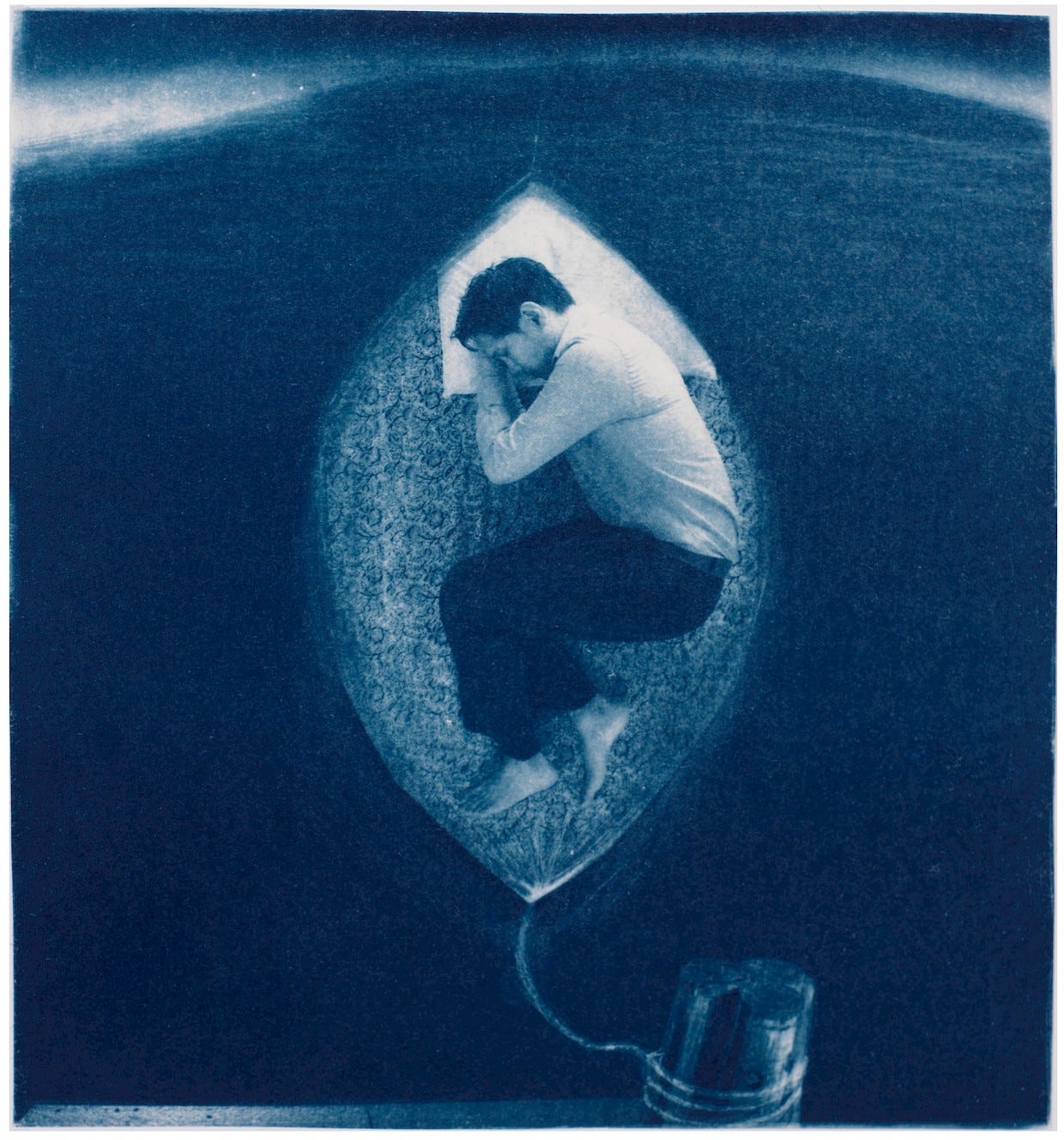
Sleep is a funny thing.
Once upon a time, I dreamed of less sleep. I fantasised about being one of those engines of productivity: the 4-hour sleepers.
As a 9-hour sleeper, I've always been fascinated by those who sleep less (the grass, as they say, is always greener). How odd that some people can function with so much less while some of us need so much more. Why? Of course, there's a cost. Sleep researcher Matthew Walker talks about the correlation between those who sleep less than six hours and dementia; in particular, he named the neoliberal two four-hour sleepers Margaret Thatcher and Ronald Reagan.
I'm currently sailing through the corpus of another 4-hour sleeper—Casey Neistat and his 500 and something consecutive daily vlogs—which has me thinking about this again. I know a couple of them myself. An old friend's mother was a journalist in the UK and rarely slept more than 4 hours. My eldest brother had a few years there of struggling to sleep a whole night (or at all).
In all these cases, we have people in love with work.
With my brother, I've gotten to see this up close. I've never met anyone with his work ethic. I'm convinced if he did a Big 5 personality test, his conscientiousness would score in the high 90s (you should see his condo—the paragon of order)1. From what I can see, his mind never really shut down; the gears were always turning. I've experienced moments like this where my mind is full steam ahead while I'm lying in bed, inevitably making sleep impossible. A mind drowning in salience doesn't fall from consciousness easily.
As far as I can figure, this is the case for all of these 4-hour sleepers.
Tim Ferriss recently interviewed Ev Williams (co-founder of Twitter, Blogger and Medium), and Williams brought up a book called Why Greatness Cannot Be Planned: The Myth of the Objective. Basic idea: if you are trying to come up with something novel and groundbreaking, goal-setting and planning aren't going to get you there.
I think of this in two ways.
The Paradigm
The first is the idea of the paradigm. Thomas Kuhn's study of the evolution of the sciences argued that most science takes place within a paradigm. The paradigm orients the scientist towards certain problems and gives an example of an acceptable solution. This vast majority of scientific work is called “Normal Science”. There are times when the paradigm reaches a crisis point and at such times we get “Revolutionary Science” (some of Kuhn's examples are Lavoisier in chemistry and Einstein in theoretical physics).
With Normal Science, the research program is given. You can probably project a thousand careers based on a paradigm. The pharmacological paradigm of psychiatry (on which the DSM was based) believed that there was a neural fingerprint for each mental condition. As such we can find the neural fingerprint and a pharmaceutical way of treating it. Decades later, faith in this pharmacological paradigm is breaking down but for many years it provided a paradigmatic world that psychiatrists, neuroscientists and biochemists inhabited and oriented them towards a solution (e.g. the depression being caused by serotonin story).
The Serotonin System
The second way I think of “the myth of the objective” goes back to Ryan Bush's work, Become Who You Are. For a deep dive into that work, there was an article a couple of years back and a podcast interview with Ryan I'd recommend.
That book taught me a lot about serotonin and sent me off down the rabbit hole of that literature. It's a fascinating neurochemical. Serotonin, among other things, structures our experience of the world. It organises our perceptual channels (the various senses) and our cognitive channels (memory, attention, mood regulation). This becomes most obvious when you mess with serotonin levels.
Psychedelics and dream sleep are two great examples. In both, the inhibition of the serotonin system breaks down these tightly regulated canals and the waters of our experience begin to do funny things. Colours become more vivid, emotions more intense, synaesthesia and distorted perception ensue.
This is creativity. Where the regular serotonin function is a well-oiled machine on which the barges of hard work flow towards their inevitable destination, inhibited serotonin is like Noah's ark floating amid the chaos of a flooded new world—making new connections as it sails off into the terra incognita. That journey is risky: whether it's a matter of hic sunt dracones (here be dragons) or pirate's gold, you just don't know.
Low serotonin is synonymous with depression. You lose motivation, you ruminate, your energy plummets: all seems futile. Low serotonin is outrageously correlated with suicide. In his classic textbook Affective Neuroscience, Jans Panksepp wrote:
“Probably the most striking and highly replicable neurochemical finding in the whole psychiatric literature is that individuals who have killed themselves typically have abnormally low brain serotonin activity.”
Bush's thesis in Become Who You Are is that this is, at least in part, an evolutionary adaptation. What you're doing isn't working. You're not doing well in the tribe and so you need to change your course.
Great; but how? This is where the myth of the objective comes in: there is no map. Your old map doesn't work so let loose the cognitive and perceptual channels and let's see what will emerge from the Petersonian Chaos of releasing “the blood-dimmed tide”. At best it seems like an evolutionary Hail Mary that's as likely to fail as often as it succeeds. But I suppose that's just the thing about risk: if it was a guaranteed strategy we'd all be doing it.
Return of the 4-Hour Sleeper
This brings us back to the 4-hour sleepers. You can only be a 4-hour sleeper when the path is certain and you are certain about the path.
If you were full of doubts about the path—about your methodology and your goal or its value—you would need more sleep. More sleep is more time in the creative chaos—more time pioneering the field of possibilities.
When I think of my 4-hour sleepers near and far, this map holds strongly. I can't help but feel that the likes of Thatcher and Reagan would have benefited from a paradigmatic update (others will of course disagree). Their maps were set, and they set their tack accordingly.
But I feel I'm still missing something about this phenomenon. The majority of us live the majority of our lives nestled comfortably in a paradigm that's working. So maybe these individuals are as distant from the peak of the bell curve as the deeply depressed. Why are they so driven? With my brother and Casey Neistat, this is a rhythm that changed, but in the case of Thatcher, Reagan and my friend's mam, it didn't. What is the nature of the fire that drives these people? I have some thoughts on that but we've already covered quite enough ground for today.
If this seems like a non sequitur then you should know that our Jordan Peterson was a leading Big 5 researcher in his day (Adam Grant quotes him in his 2013 book Give and Take a few years before Peterson became a public figure) and one of his contributions was identifying the two components to trait Conscientiousness: Industriousness and Orderliness.
As a 6-hour sleeper my takeaway is that I have achieved the perfect balance between serotonin replenishment and time wasting. Also, do naps count? How about biphasic sleep?
I think the 4-hour sleepers align their methods of inquiry with their intellectual preoccupations, making all their work an interesting exploration. They are able to learn in their idiosyncratic ways, and still produce or are in the process of producing value in the terms of the present world, making it activities worth pursuing and pushing through. Their meaning making process is on high drive.