

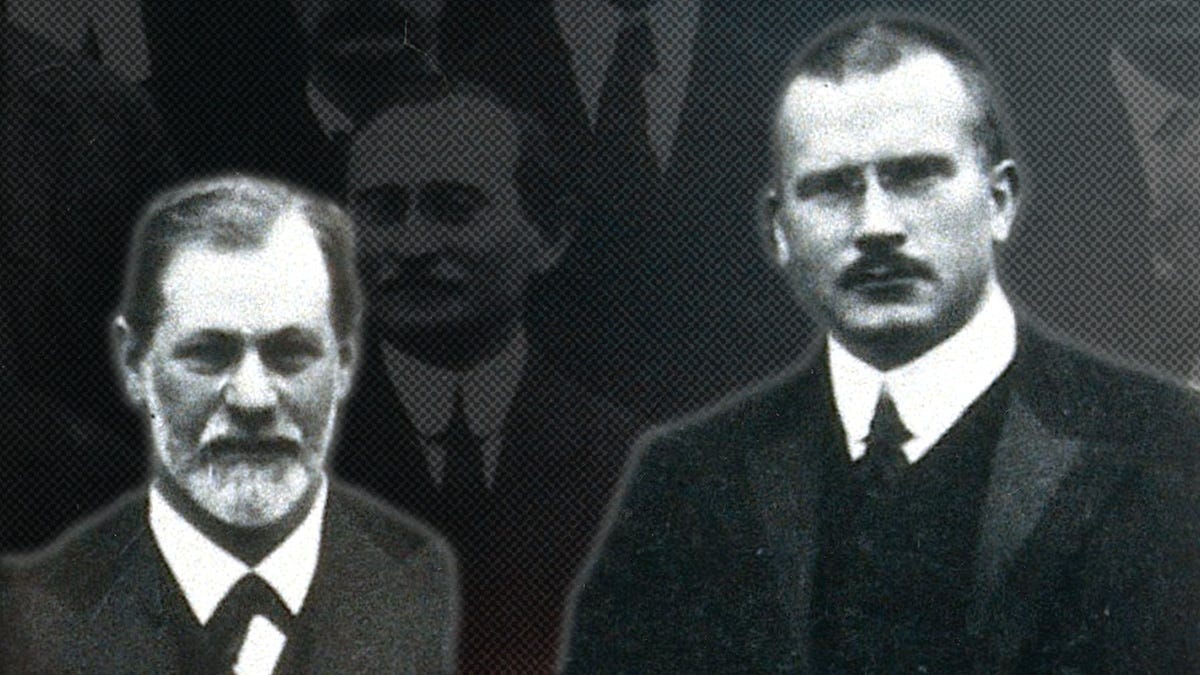
I’ve been digging into the (surprisingly) sad, fallible story of Freud and Jung’s falling out recently. It’s a lot more human than you’d expect — with all the love and pettiness that humanness brings.
More on that soon. Today, I want to zoom in on one rich slice of this Freud/Jung story overflowing with this humanness. It’s an argument they had three years before their falling out in 1912, and the letter Freud wrote to Jung in April 1909 about it.
The synchronistic context
A little context: Jung visited the maestro in Vienna shortly before this letter, and they had a bit of a tiff.
Freud asked Jung to cool it on the occult stuff. Freud had a good mind for strategy and optics — learned in the trenches of wholesale ostracism he had spent his career in. There were already enough challenges getting respect from the scientific establishment as it was; Freud felt the woo-woo voodoo was only going to make it easier for the critics to dismiss the movement. Jung got a little triggered. Here’s his account of what went down:
“While Freud was going on this way, I had a curious sensation. It was as if my diaphragm were made of iron and were becoming red-hot — a glowing vault. And at that moment there was such a loud report in the bookcase, which stood right next to us, that we both started up in alarm, fearing the thing was going to topple over on us. I said to Freud: “There, that is an example of a so-called catalytic exteriorisation phenomenon.”
“Oh come,” he exclaimed. “That is sheer bosh.”
“It is not,” I replied. “You are mistaken, Herr Professor. And to prove my point I now predict that in a moment there will be another loud report!” Sure enough, no sooner had I said the words than the same detonation went off in the bookcase.” (Jung 1989, p.155)
This is how Jung recalled the event decades later in his autobiography, Memories, Dreams, Reflections. He said that Freud merely “stared aghast” at him, and they never spoke of the event again. But Jung’s memory was playing tricks on him because Freud did speak of it again, and this is where our letter from April 16th 1909 comes in.
Fatherly Freud
Throughout the letter (which you can read in full here1), we get Freud’s hurt paternal feelings. It reads a lot like a father mourning his rebellious teenage son. It’s equal parts sad and endearing:
“It is remarkable that on the same evening that I formally adopted you as an eldest son, anointing you as my successor and crown prince — in partibus infidelium [in the lands of the unbelievers] — that then and there you should have divested me of any paternal dignity, and that the divesting seems to have given you as much pleasure as investing your person gave me. Now I am afraid that I must fall back again to the role of father towards you in giving you my views on poltergeist phenomena. I must do this because these things are different from what you would like to think.” (Jung 1989, p.361)
Poor Freud. Later on, after he lays out his arguments against Jung’s interpretation, we get more of these paternal vibes:
“I therefore don once more my horn-rimmed paternal spectacles and warn my dear son to keep a cool head and rather not understand something than make such great sacrifices for the sake of understanding. I also shake my wise grey locks over the question of psychosynthesis and think: Well, that is how the young folks are; they really enjoy things only when they need not drag us along with them, where with our short breath and weary legs we cannot follow.” (Jung 1989, p.362)
And from there, he goes on to make a repair attempt with Jung and show him some of his own superstitions in an attempt to bridge the divide. It warms my heart. It’s a mere sliver of a relationship, but there’s so much love in there and so much of the give and take and compromise of human relationship.
Of course, you can easily make the case for Freud the tyrant, ostracising Adler, Stekel, Rank, Ferenczi and of course Jung. That fits more with my old image of Freud and the picture that Jung paints of him in Memories, Dreams, Reflections. Reading the letters though, the vibes are different. I see a man who loves another like a son and is hurt when the latter withdraws from him and rejects him. As we’ll see in the longer piece, the cause of their falling out is more on Jung’s side than Freud’s (for equally human reasons).
Jung’s charisma
In the letter, Freud admits the event “made a powerful impression upon me”, but he wasn’t sold (see: “that is sheer bosh”), and so, after Jung’s departure, he did some investigation. It is here that Freud uses a lovely turn of phrase that cracks open a whole can of worms on Jung that merits a deep study in itself. He says that when Jung left, he was free from “the spell of your personal presence”. Delicious.
This is something I’d love to write about in future — the personal charisma of Carl Jung. Such was Jung’s personal power that, in the moment, he convinced Freud that something supernatural had happened.
It brings to mind Max Weber’s distinction between the priests in the cities and magicians in the countryside. The priests were more like our academics — following the words of the holy books, highly literate and organised. The rural magicians, however, were charismatic (in fact, this usage of the term by Max Weber is where we get our modern concept of charisma from2).
In comparison to the dry academic authority of the priest, the authority of the magician type was more…magical. Their esteem came from otherworldly sources — altered states, visions, possession and journeys. The magicians were less academic theologians than ayahuasca-drunk, psychic channelling hypnotists. They were masters of ecstasy and trance, performing seeming miracles.
If all that makes you think of cult leaders, I’m right there with you. And Jung definitely had that cult leader charisma about him — that sense of an entrancing personality. Freud was a priest from the city; Jung was a magician from the wild Swiss hills.
If you’ve ever met a magician type, you’ll know what an unusual experience it is. Your perception of reality warps around these charismatic figures. I have a close friend cut from this cloth. Since we were teenagers, the joke in the group was that he was going to become a cult leader some day. Like Jung, he had his experiences with psychosis (his induced by a little too much DMT). He spent most of his 20s deep in Vipassana, working up to the 20- and 30-day silent retreats.
My friend was always a frustrating person to argue with because he was dead certain about everything he said. Best-case scenario, you’d wait a couple of weeks, and he’d be espousing your view, saying you’d been partly right but missing the critical piece he had since figured out. I’m making him sound like a terror, but he was (and is) also a delight, an incredibly loyal and caring friend and one of the more interesting people you’ll ever meet.
This kind of charisma is intoxicating. When you fall under the spell of such a magician, your sense of reality begins to shift, and the world becomes an enchanted place. Evidently, Jung had this Weberian charisma in spades.
If this theme of charisma interests you, you’ll really enjoy the podcast with Layman Pascal. And probably also the article on Weber’s three religious types (the third being the prophet). End of sidebar; back to letter.
Back to the letter
To Jung’s mind, Freud dismissed his occult interests totally out of hand:
“Because of his materialistic prejudice, he rejected this entire complex of questions as nonsensical, and did so in terms of so shallow a positivism” (Jung 1989, p.155)
But that’s not what happened at all. As Jung himself admits, Freud did later go deep into the same subject; he “recognised the seriousness of parapsychology and acknowledged the factuality of “occult” phenomena.” That’s not a normal thing for a materialist positivist to do, and so if you’re looking for my official statement on the matter, I think Jung is being rather unfair to Freud here (as any true materialist positivist who is acquainted with Freud’s oeuvre will undoubtedly agree).
Anyway, after the spell of Jung’s presence had faded, Freud did some sciencing:
“At first I was inclined to ascribe some meaning to it if the noise we heard so frequently when you were here were never heard again after your departure. But since then it has happened over and over again, yet never in connection with my thoughts and never when I was considering you or your special problem. (Not now, either, I add by way of challenge.)” (Jung 1989, p.361)
In the end, Freud dismissed the magical event, but despite this, he extended an olive branch to Jung, sharing an irrational superstition of his own:
“Now I shall exercise the privilege of my years to turn loquacious and tell you about one more matter between heaven and earth which cannot be understood. A few years ago I took it into my head that I would die between the ages of 61 and 62, which at that time seemed to leave me a decent period of grace. (To-day that leaves me only eight years still to go.) Shortly afterwards I made a trip to Greece with my brother, and it was absolutely uncanny to see how the number 61, or 62 in conjunction with 1 and 2, kept cropping up on anything that had a number, especially on vehicles. I conscientiously noted down these occasions. By the time we came to Athens, I was feeling depressed. At our hotel we were assigned rooms on the second floor, and I hoped I could breathe again — at least there could be no chance of No. 61. However, it turned out that my room was No. 31 (which, with fatalistic licence, I regarded as after all half of 61–62). This wilier and nimbler figure proved to be even better at dogging me than the first.
From that day until very recently the number 31 remained faithful to me, with a 2 all too readily associated with it. But since I also have in my psychic system regions in which I am merely avid for knowledge and not at all superstitious, I have attempted to analyse this conviction. Here it is. My conviction began in 1899. Two events coincided at that time. The first was my writing The Interpretation of Dreams (which, you know, is dated ahead to 1900); the second, my being assigned a new telephone number, which I have to this day: 14362. It is easy to establish a link between these two facts: in the year 1899, when I wrote The Interpretation of Dreams, I was 43 years old. What should be more obvious than that the other figures in my telephone number were intended to signify the end of my life, hence, 61 or 62? Suddenly there appears a method in this madness. The superstition that I would die between 61 and 62 turns out to be equivalent to the conviction that with the book on dreams I had completed my life work, needed to say no more, and could die in peace. You will grant that after this analysis it no longer sounds so nonsensical.” (Jung 1989, pp.362-3)
Don’t you love it? History tries to put a sombre visage on our rise from sordid ignorance into the light of reason. But then you scratch the surface a little, and you find we are so wonderfully nuts just under the surface. What I appreciate about Freud is his ability to hold both the superstition and its negation in his mind at once. He doesn’t just shamefully file away the superstition and ignore it. He went searching for its origin and the logic behind it.
But, grand historical reflections aside, I love the human event that’s happening here. Freud has challenged Jung’s supernatural event, but he isn’t tyrannically telling him to wise up. Instead, he tries to build a bridge. He tries to share his own irrationality even if it is embarrassing for him. That’s sweet. I’m drawn to Freud’s humanity here — not just in the repair attempt with Jung but in his self-critical doubt and in his curiosity and openness to unconventional truths. I don’t know about you, but I can relate to that a lot.
I’m also quite partial to Freud’s explanation for the emergence of this type of superstition:
“I only want to say that adventures such as mine with the number 62 can be explained by two things. The first is an enormously intensified alertness on the part of the unconscious, so that one is led like Faust to see a Helen in every woman. The second is the undeniable “co-operation of chance,” which plays the same role in the formation of delusions as somatic co-operation in hysterical symptoms or linguistic co-operation in puns.”
Bibliography:
Jung, C.G. (1989) Memories, Dreams, Reflections. New York: Vintage Books
Technically not full. There’s a little missing at the start, but there’s no linkable copy of the Freud/Jung letters book online unfortunately. If you do happen to have the Freud/Jung letters, it’s letter 139 F (p.218 in my copy)
Though technically it was a theological term before, so not a coinage, more of a rebranding, secularising and popularising