


Names for concept: The Paradigm Gap, The Ideological Chasm
Thinker of Origin: Thomas Kuhn x The Living Philosophy
School of Origin: Philosophy of Science, History of Ideas
Related Concepts: the Petersonian Peacemaker, the Prophet archetype, the dark night of the soul, the Edge of the Inside
Why it matters:
Understanding how belief change works: not simply about an atomic belief
Why we cling to bad systems: it’s better than no system
Constellations can be changed! It’s called a paradigm shift
We tend to think of belief change as rational and modular. After some logical considerations are raised, you change your position. You cull the false belief from your neural network and move on with your rational life.
But as we saw in an earlier instalment of The Philosopher’s Toolkit on Clusters and Constellations, beliefs tend to rove in packs. Their nature is not rational but mimetic and memetic, i.e. they are socially transmitted infections. Your beliefs don’t come from long nights of logic-ing, but, like a social little sponge, you absorb them from the folks around you.
This quirk of human nature is what makes political and social arguments such an infuriating nuisance.
As we saw in last week’s instalment, in his (quite literally) Paradigm-defining work Thomas Kuhn explores this pack nature of human belief in the context of science. The constellation is the centrepiece of Kuhn’s definition of the term paradigm:
“the term ‘paradigm’ […] stands for the entire constellation of beliefs, values, techniques, and so on shared by the members of a given community.” (Kuhn 1970:175)
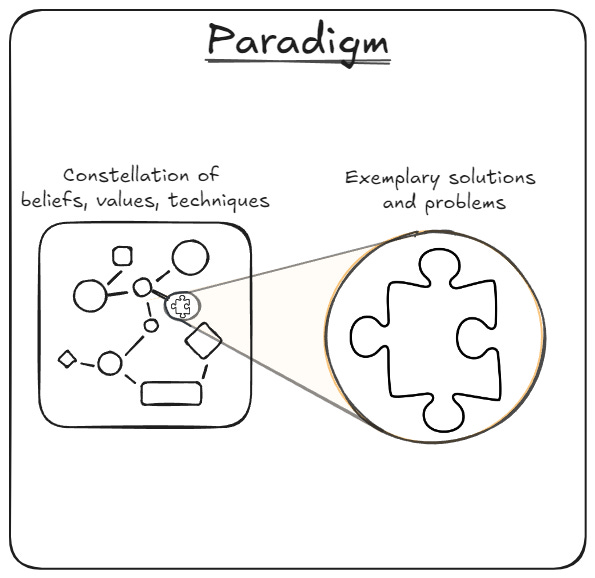
Contrary to Scientism’s image of science as a rational process, it turns out to be as human as moaning and gossip:
“the act of judgment that leads scientists to reject a previously accepted theory is always based upon more than a comparison of that theory with the world.” (Kuhn 1970: 77)
The upshot of this is that scientists don’t give their paradigms up easily:
“Though they may begin to lose faith and then to consider alternatives, they do not renounce the paradigm that has led them into crisis.” (Kuhn 1970: 77)
And here’s the kicker: when they do abandon their paradigm, it’s only because they’ve become believers in another:
“The decision to reject one paradigm is always simultaneously the decision to accept another” (Kuhn 1970:151)
If you think about it, this makes a lot of sense. If you abandon your paradigm because of its flaws, you’ve lost all sense of orientation. You can’t do science without it (or at least you are back to a pre-paradigmatic stage of science). Caught between a bad explanation that lets us continue playing scientist, and the truer story about the holes in that bad explanation, it’s infinitely more satisfying to play scientist.
Feature fury
“Science proceeds one funeral at a time” — Max Planck
If you’re thinking that this is a bug that could be eliminated if flawed humans were replaced by a perfect AI superintelligentsia, Kuhn would disagree. This is a feature, not a bug:
“Lifelong resistance, particularly from those whose productive careers have committed them to an older tradition of normal science, is not a violation of scientific standards but an index to the nature of scientific research itself” (Kuhn 1970: 151)
Feature though it may be, it doesn’t mean it’s not downright infuriating when you have a head-on collision with it. When you’re arguing with a person whose worldview is in desperate need of an update, cognisance of this fact isn’t likely to help your poor sympathetic nervous system. Interactions with people in this moment of paradigmatic frailty can feel a bit like talking to an NPC — “stubborn and pigheaded”, to use Kuhn’s adjectives of choice.

If most scientists persist “stubborn and pigheaded” with the outdated paradigm, then a vacuum opens up. Things aren’t working like they’re supposed to.
Back in 1971, Arthur Burns, Nixon’s head of the Federal Reserve, was failing spectacularly to get a handle on the country’s inflation. In a candid confession of paradigmatic crisis, Burns told a congressional committee,
“The rules of economics are not working the way they used to.”
Burns’ paradigm collided with reality and its demise opened a gap into which Neoliberal economics trickled over the next decade until it became the dominant paradigm of the 80s.
Such crises are not so uncommon. You can see US Democrats going through a MAJOR one right now. The New Left constellation which they’ve worn as an ideological mask appears to have run out of steam (if the many eulogies on the death of Wokeism are to be believed — I recommend this one). And so too is the entire liberal attitude of Western nations faced with the rise of Populism (more on that next time).
How do you get there from here?
How do we get from one paradigm to another? Compare this Kuhn quote about paradigm crisis times with what’s going on with the US Democrat party since the last election:
“Confronted with anomaly or with crisis, scientists take a different attitude toward existing paradigms, and the nature of their research changes accordingly. The proliferation of competing articulations, the willingness to try anything, the expression of explicit discontent, the recourse to philosophy and to debate over fundamentals, all these are symptoms of a transition from normal to extraordinary research. It is upon their existence more than upon that of revolutions that the notion of normal science depends.” (pp.90–91)
So the paradigm as a whole sinks into a miasma of doubt and conflict. Some go into denial pretending there is no problem (and as Planck’s quote above suggests, will go to their graves this way). But in general, the crisis of confidence drives some in search of new solutions (and some, god help them, to philosophy). These novel solutions don’t come from the expert and the tenured. Instead, they are the ones:
“so young or so new to the crisis-ridden field that practice has committed them less deeply than most of their contemporaries to the world view and rules determined by the old paradigm.”
They don’t have the sunk costs that the elite have. This, of course, takes us back to another notion we’ve talked a lot about on The Living Philosophy: the Edge of the Inside. This is the idea that change comes not from the gilded priestly caste from the temple at the centre of the community but from the inspired, passionate prophet at the edge of the inside — one of us, but uncaptured by institutions and thus free to think clearly and speak their truth1.
Zohran Mamdani’s victory over Cuomo in the New York mayoral Democratic primaries is a perfect example and may point to the Democratic Socialists as being the new paradigm for the Democratic party as a whole.
This would dovetail neatly with the Burns economics example. Neoliberal thought was well-established by the 1970s (in fact, it was already alive and kicking with the Mount Pelerin Society’s foundation in 1947), but it took a crisis in the prevailing model for this more obscure model to achieve saturation.
Symmetrically, the Democratic Socialist movement has been around for some time and may now get its moment given the spectacular failure of its antecedent.
The Paradigm Gap
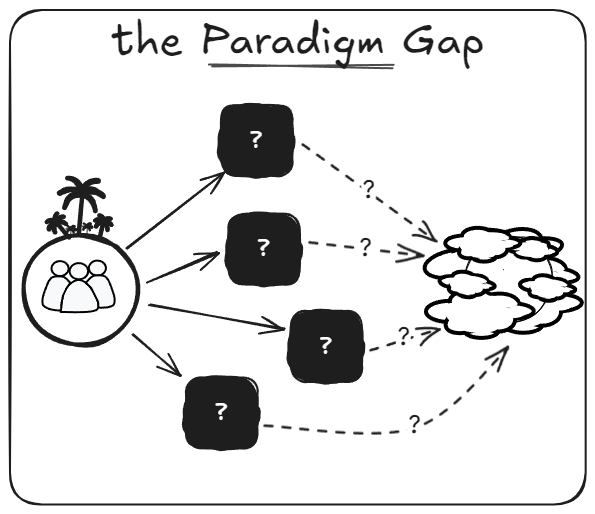
What we have then is a gap. There is recognition that the paradigm isn’t all it’s cracked up to be. The belly of the bell curve will say everything’s fine — at most, our little dam needs a patch and so they go about stuffing their thumbs in the dam.
Others go in search of a better answer.
When you have given up on the old, but there is no new yet to emerge into, you have entered The Paradigm Gap. It is the space of aporia between two certainties, the question mark between two answers. It is the slouching towards Bethlehem2. This is the no-man’s land where “the best lack all conviction”; it’s the labyrinth without a guaranteed solution.
There’s nothing out here to be tribal about. This is the desert. You can’t count on institutional support. You’re just one pilgrim among many who might strike gold or who might turn out to be a nutso crank (in which case, let us all pray you’re not a head-the-ball like Columbus, which is to say, let’s not go getting too romantic about this pioneer archetype).
The “stubborn and pigheaded” aren’t the creators of change. They stay in their comfortable paradigms “full of passionate intensity”, while the nomads take off into the Paradigm Gap in search of a new paradigm. Some one of these pioneers will be the founder/discoverer of a new paradigm, at which point, a whole new herd of “stubborn and pigheaded” can explore, map out, develop, and, in the end, defend.
This has been another instalment of The Philosopher’s Toolkit. For an introduction to the series see here. It was inspired by two things: Deleuze’s definition of philosophy as ”forming, inventing and fabricating concepts” and the old saying that “if all you have is a hammer, every problem begins to look like a nail”. The aim of the Philosopher’s Toolkit is to give you more tools for interacting with the world.
Bibliography:
Kuhn, T. 1970. The Structure of Scientific Revolutions. Second Edition, Enlarged. Chicago: The University of Chicago
an allusion to Yeats’ poem The Second Coming whose entirety is pretty damn relevant here — check out last week’s poetry club.